
Python Set intersection()
In this tutorial, we will learn about the Python Set intersection() method with the help of examples.
The intersection() method returns a new set with elements that are common to all sets.
Example
A = {2, 3, 5}
B = {1, 3, 5}

# compute intersection between A and B
print(A.intersection(B))


# Output: {3, 5}
Syntax of Set intersection()
The syntax of intersection() in Python is:
A.intersection(*other_sets)
intersection() Parameters
intersection() allows arbitrary number of arguments (sets).
Note: * is not part of the syntax. It is used to indicate that the method allows arbitrary number of arguments.
Return Value from Intersection()
intersection() method returns the intersection of set A with all the sets (passed as argument).
If the argument is not passed to intersection(), it returns a shallow copy of the set (A).
Example 1: Python Set intersection()
A = {2, 3, 5, 4}
B = {2, 5, 100}
C = {2, 3, 8, 9, 10}

print(B.intersection(A))
print(B.intersection(C))
print(A.intersection(C))

print(C.intersection(A, B))
Output
{2, 5}
{2}
{2, 3}
{2}
Working of Set intersection()
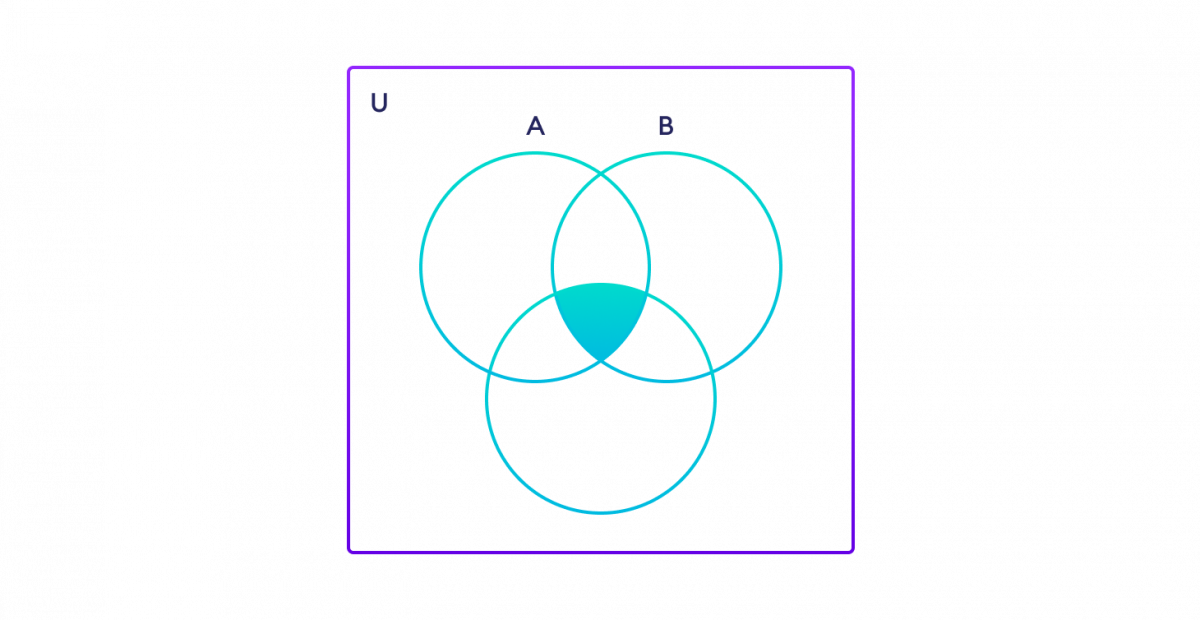
The intersection of two or more sets is the set of elements that are common to all sets. For example:
A = {1, 2, 3, 4}
B = {2, 3, 4,  9}
C = {2, 4, 9 10}

Then,
A∩B = B∩A ={2, 3, 4}
A∩C = C∩A ={2, 4}
B∩C = C∩B ={2, 4, 9}

A∩B∩C = {2, 4}
More Examples
A = {100, 7, 8}
B = {200, 4, 5}
C = {300, 2, 3}
D = {100, 200, 300}

print(A.intersection(D))
print(B.intersection(D))
print(C.intersection(D))
print(A.intersection(B, C, D))
Output
{100}
{200}
{300}
set()
Example 3: Set Intersection Using & operator
You can also find the intersection of sets using & operator.
A = {100, 7, 8}
B = {200, 4, 5}
C = {300, 2, 3, 7}
D = {100, 200, 300}

print(A & C)
print(A & D)

print(A & C & D)

print(A & B & C & D)
Output
{7}
{100}
set()
set()
Also Read:


