Doubly Linked List
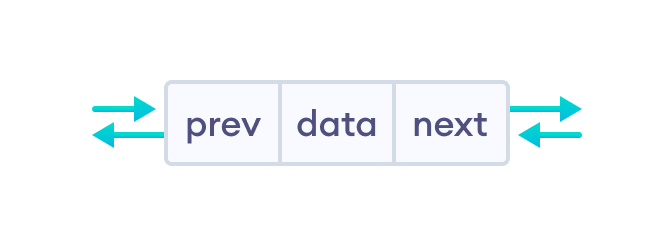
A doubly linked list is a type of linked list in which each node consists of 3 components:
*prev- address of the previous nodedata- data item*next- address of next node
Note: Before you proceed further, make sure to learn about pointers and structs.
Representation of Doubly Linked List
Let's see how we can represent a doubly linked list on an algorithm/code. Suppose we have a doubly linked list:

Here, the single node is represented as
struct node {
    int data;
    struct node *next;
    struct node *prev;
}
Each struct node has a data item, a pointer to the previous struct node, and a pointer to the next struct node.
Now we will create a simple doubly linked list with three items to understand how this works.
/* Initialize nodes */
struct node *head;
struct node *one = NULL;
struct node *two = NULL;
struct node *three = NULL;

/* Allocate memory */
one = malloc(sizeof(struct node));
two = malloc(sizeof(struct node));
three = malloc(sizeof(struct node));

/* Assign data values */
one->data = 1;
two->data = 2;
three->data = 3;

/* Connect nodes */
one->next = two;
one->prev = NULL;

two->next = three;
two->prev = one;

three->next = NULL;
three->prev = two;

/* Save address of first node in head */
head = one;
In the above code, one, two, and three are the nodes with data items 1, 2, and 3 respectively.
- For node one:
nextstores the address oftwoandprevstoresnull(there is no node before it) - For node two:
nextstores the address ofthreeandprevstores the address ofone - For node three:
nextstoresnull(there is no node after it) andprevstores the address oftwo.
Note: In the case of the head node, prev points to null, and in the case of the tail pointer, next points to null. Here, one is a head node and three is a tail node.
Insertion on a Doubly Linked List
Pushing a node to a doubly-linked list is similar to pushing a node to a linked list, but extra work is required to handle the pointer to the previous node.
We can insert elements at 3 different positions of a doubly-linked list:
Suppose we have a double-linked list with elements 1, 2, and 3.
1. Insertion at the Beginning
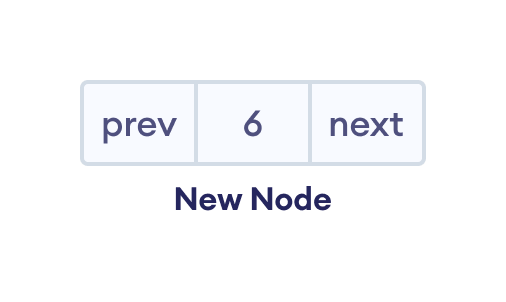
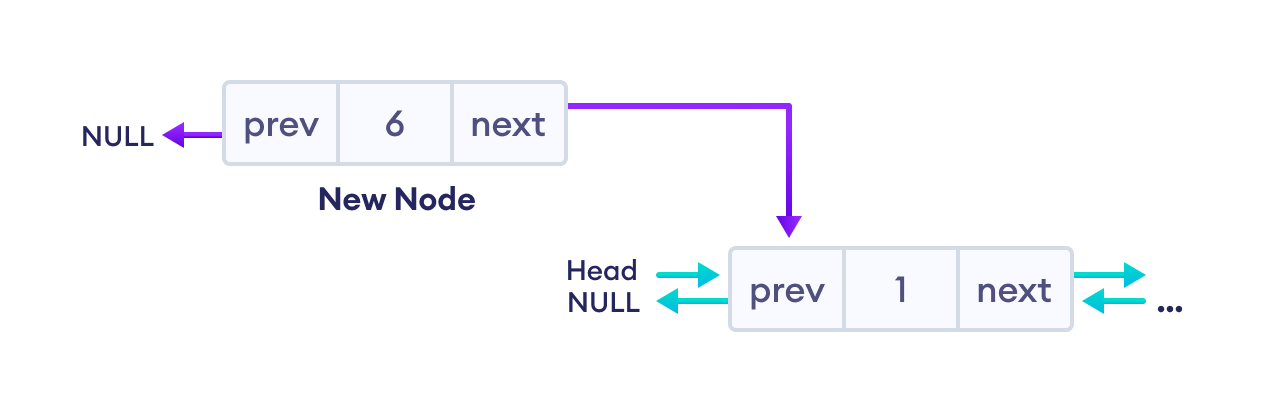
Let's add a node with value 6 at the beginning of the doubly linked list we made above.
1. Create a new node
- allocate memory for
newNode - assign the data to
newNode.
2. Set prev and next pointers of new node
- point
nextofnewNodeto the first node of the doubly linked list - point
prevtonull
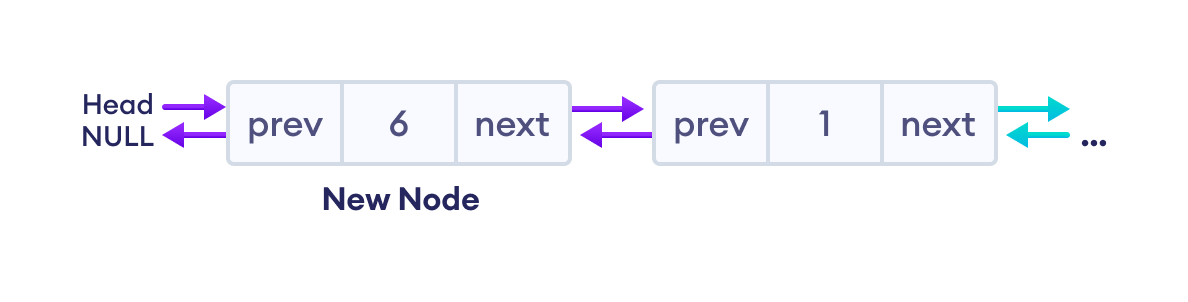
3. Make new node as head node
- Point
prevof the first node tonewNode(now the previousheadis the second node) - Point
headtonewNode
Code for Insertion at the Beginning
// insert node at the front
void insertFront(struct Node** head, int data) {

    // allocate memory for newNode
    struct Node* newNode = new Node;

    // assign data to newNode
    newNode->data = data;

    // point next of newNode to the first node of the doubly linked list
    newNode->next = (*head);

    // point prev to NULL
    newNode->prev = NULL;

    // point previous of the first node (now first node is the second node) to newNode
    if ((*head) != NULL)
        (*head)->prev = newNode;

    // head points to newNode
    (*head) = newNode;
}
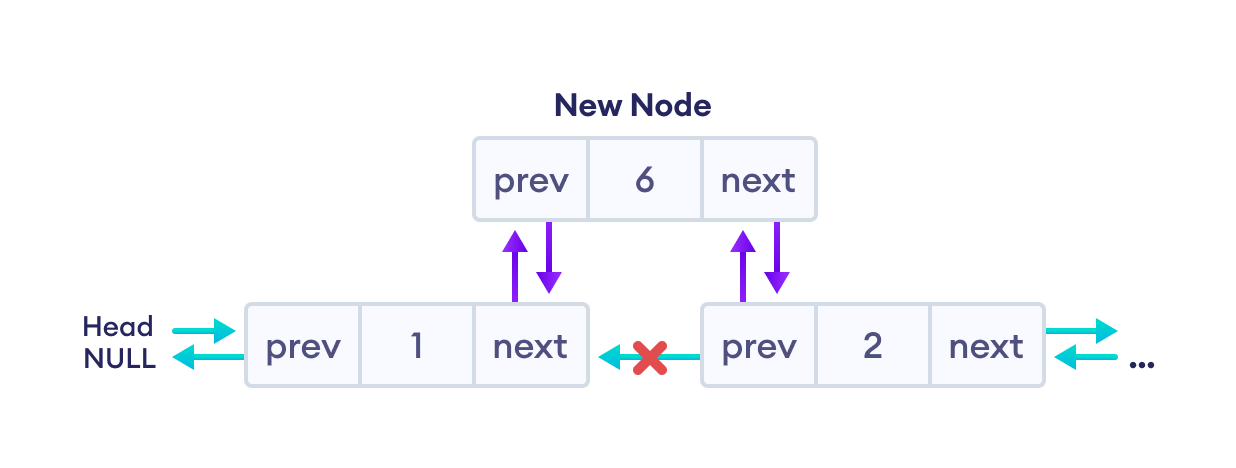
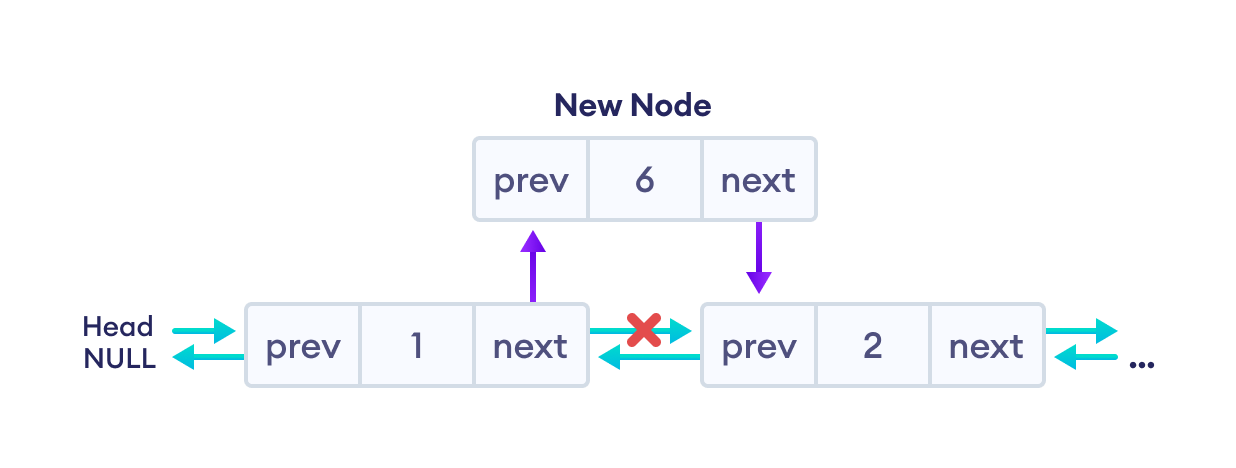
2. Insertion in between two nodes
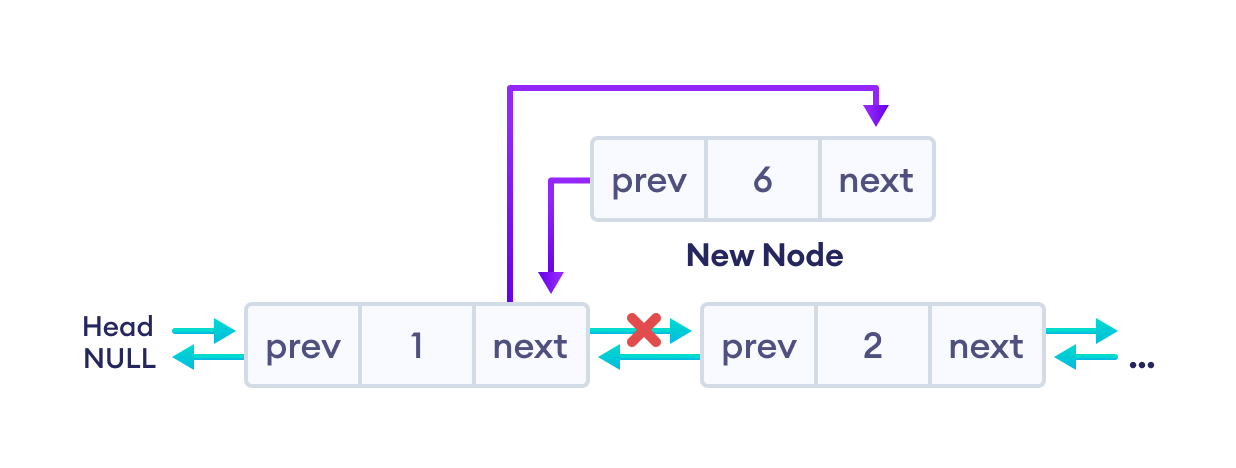
Let's add a node with value 6 after node with value 1 in the doubly linked list.
1. Create a new node
- allocate memory for
newNode - assign the data to
newNode.
2. Set the next pointer of new node and previous node
- assign the value of
nextfrom previous node to thenextofnewNode - assign the address of
newNodeto thenextof previous node
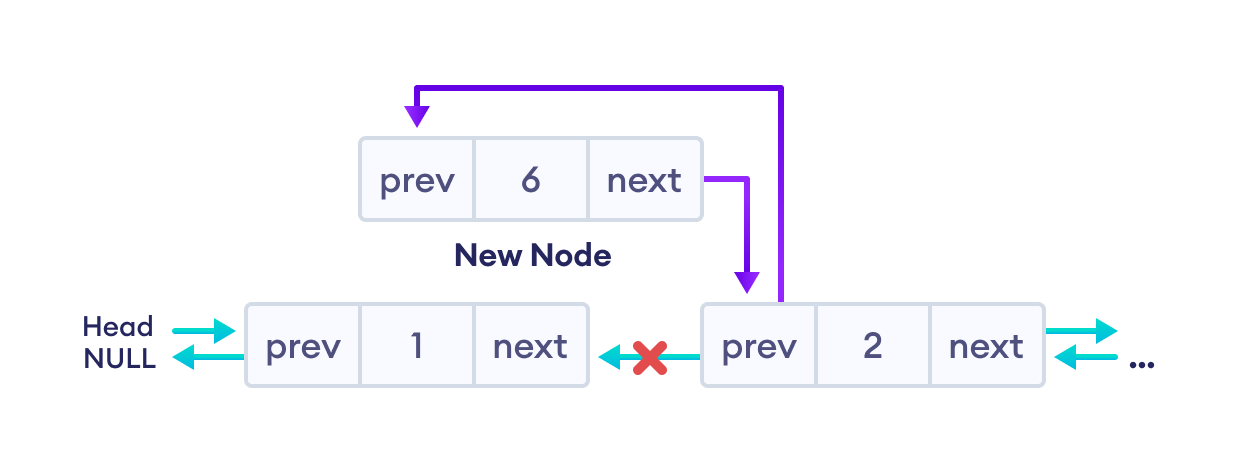
3. Set the prev pointer of new node and the next node
- assign the value of
prevof next node to theprevofnewNode - assign the address of
newNodeto theprevof next node
The final doubly linked list is after this insertion is:

Code for Insertion in between two Nodes
// insert a node after a specific node
void insertAfter(struct Node* prev_node, int data) {

    // check if previous node is NULL
    if (prev_node == NULL) {
        cout << "previous node cannot be NULL";
        return;
    }

    // allocate memory for newNode
    struct Node* newNode = new Node;

    // assign data to newNode
    newNode->data = data;

    // set next of newNode to next of prev node
    newNode->next = prev_node->next;

    // set next of prev node to newNode
    prev_node->next = newNode;

    // set prev of newNode to the previous node
    newNode->prev = prev_node;

    // set prev of newNode's next to newNode
    if (newNode->next != NULL)
        newNode->next->prev = newNode;
}
3. Insertion at the End
Let's add a node with value 6 at the end of the doubly linked list.
1. Create a new node
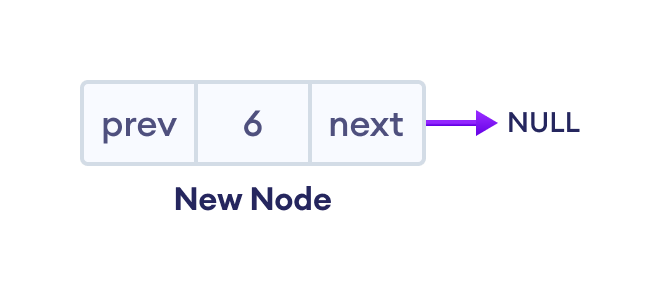
2. Set prev and next pointers of new node and the previous node
If the linked list is empty, make the newNode as the head node. Otherwise, traverse to the end of the doubly linked list and
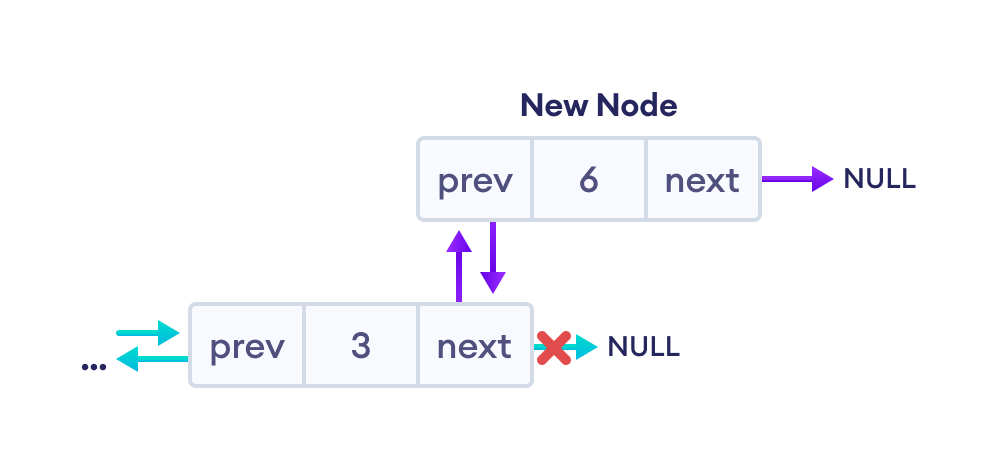
The final doubly linked list looks like this.

Code for Insertion at the End
// insert a newNode at the end of the list
void insertEnd(struct Node** head, int data) {
    // allocate memory for node
    struct Node* newNode = new Node;

    // assign data to newNode
    newNode->data = data;

    // assign NULL to next of newNode
    newNode->next = NULL;

    // store the head node temporarily (for later use)
    struct Node* temp = *head;

    // if the linked list is empty, make the newNode as head node
    if (*head == NULL) {
        newNode->prev = NULL;
        *head = newNode;
        return;
    }

    // if the linked list is not empty, traverse to the end of the linked list
    while (temp->next != NULL)
        temp = temp->next;

    // now, the last node of the linked list is temp

    // point the next of the last node (temp) to newNode.
    temp->next = newNode;

    // assign prev of newNode to temp
    newNode->prev = temp;
}
Deletion from a Doubly Linked List
Similar to insertion, we can also delete a node from 3 different positions of a doubly linked list.
Suppose we have a double-linked list with elements 1, 2, and 3.
1. Delete the First Node of Doubly Linked List
If the node to be deleted (i.e. del_node) is at the beginning
Reset value node after the del_node (i.e. node two)
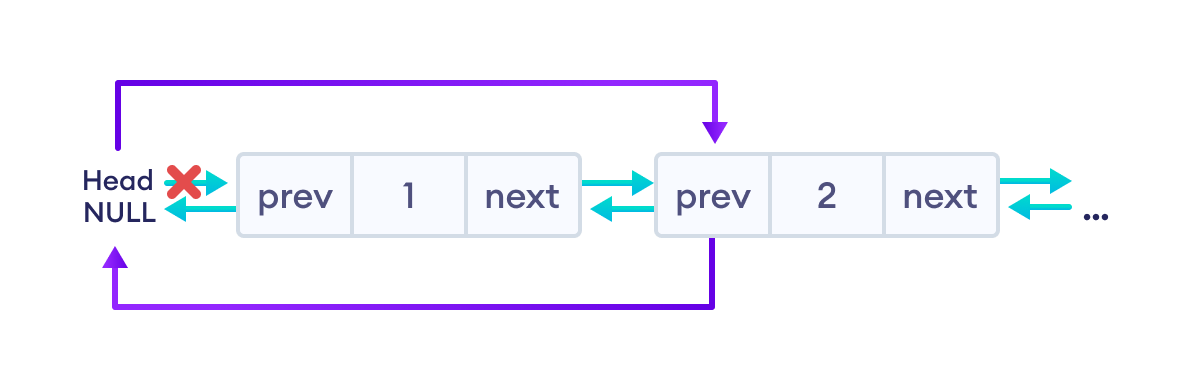
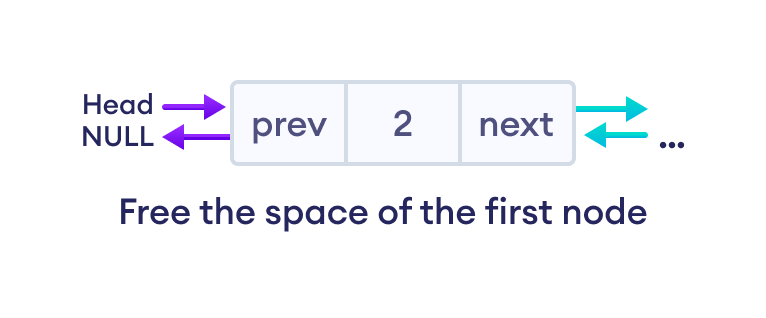
Finally, free the memory of del_node. And, the linked will look like this
Code for Deletion of the First Node
if (*head == del_node)
    *head = del_node->next;

if (del_node->prev != NULL)
    del_node->prev->next = del_node->next;

free(del);
2. Deletion of the Inner Node
If del_node is an inner node (second node), we must have to reset the value of next and prev of the nodes before and after the del_node.
For the node before the del_node (i.e. first node)
Assign the value of next of del_node to the next of the first node.
For the node after the del_node (i.e. third node)
Assign the value of prev of del_node to the prev of the third node.
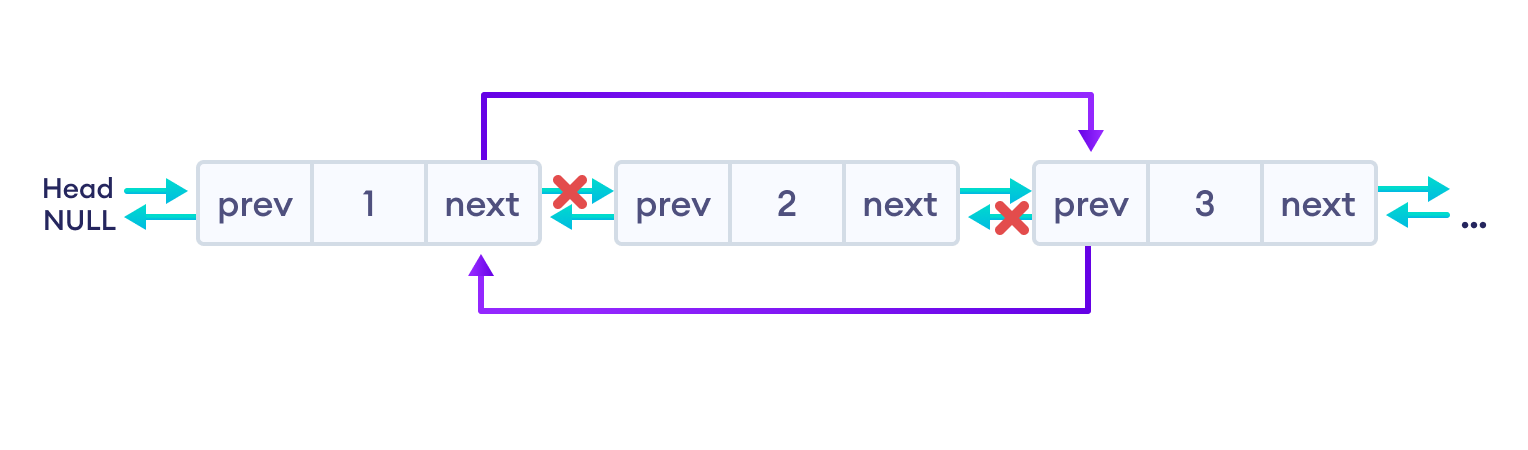
Finally, we will free the memory of del_node. And, the final doubly linked list looks like this.
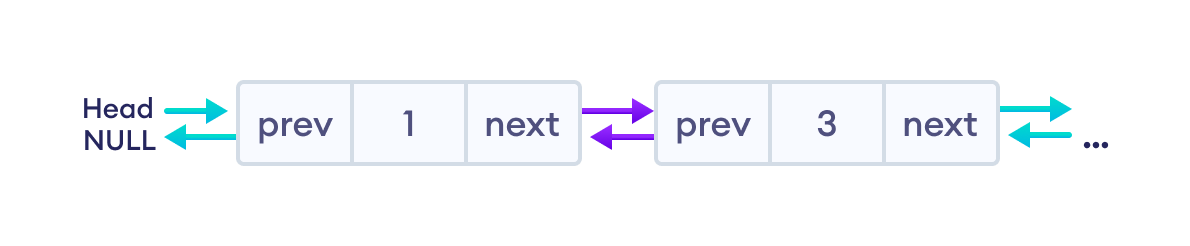
Code for Deletion of the Inner Node
if (del_node->next != NULL)
    del_node->next->prev = del_node->prev;

if (del_node->prev != NULL)
    del_node->prev->next = del_node->next;
3. Delete the Last Node of Doubly Linked List
In this case, we are deleting the last node with value 3 of the doubly linked list.
Here, we can simply delete the del_node and make the next of node before del_node point to NULL.
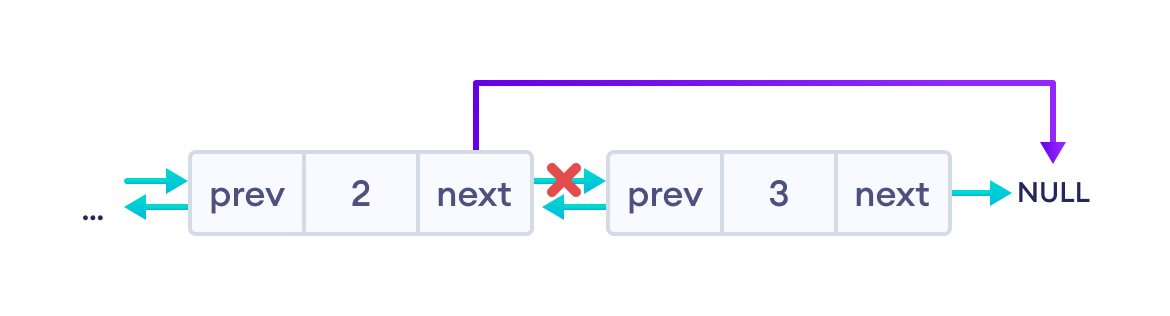
The final doubly linked list looks like this.
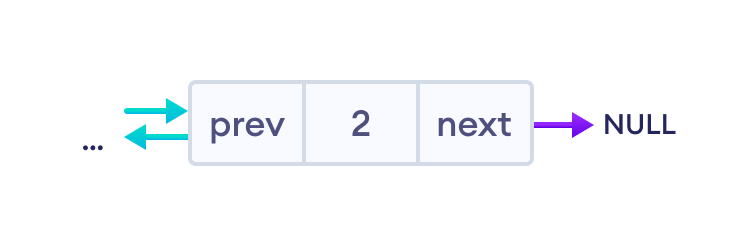
Code for Deletion of the Last Node
if (del_node->prev != NULL)
    del_node->prev->next = del_node->next;
Here, del_node ->next is NULL so del_node->prev->next = NULL.
Note: We can also solve this using the first condition (for the node before del_node) of the second case (Delete the inner node).
Doubly Linked List Code in Python, Java, C, and C++
import gc

# node creation

class Node:

    def __init__(self, data):
        self.data = data
        self.next = None
        self.prev = None


class DoublyLinkedList:

    def __init__(self):
        self.head = None

    # insert node at the front
    def insert_front(self, data):

        # allocate memory for newNode and assign data to newNode
        new_node = Node(data)

        # make newNode as a head
        new_node.next = self.head

        # assign null to prev (prev is already none in the constructore)

        # previous of head (now head is the second node) is newNode
        if self.head is not None:
            self.head.prev = new_node

        # head points to newNode
        self.head = new_node

    # insert a node after a specific node
    def insert_after(self, prev_node, data):

        # check if previous node is null
        if prev_node is None:
            print("previous node cannot be null")
            return

        # allocate memory for newNode and assign data to newNode
        new_node = Node(data)

        # set next of newNode to next of prev node
        new_node.next = prev_node.next

        # set next of prev node to newNode
        prev_node.next = new_node

        # set prev of newNode to the previous node
        new_node.prev = prev_node

        # set prev of newNode's next to newNode
        if new_node.next:
            new_node.next.prev = new_node

    # insert a newNode at the end of the list
    def insert_end(self, data):

        # allocate memory for newNode and assign data to newNode
        new_node = Node(data)

        # assign null to next of newNode (already done in constructor)

        # if the linked list is empty, make the newNode as head node
        if self.head is None:
            self.head = new_node
            return

        # store the head node temporarily (for later use)
        temp = self.head

        # if the linked list is not empty, traverse to the end of the linked list
        while temp.next:
            temp = temp.next

        # now, the last node of the linked list is temp

        # assign next of the last node (temp) to newNode
        temp.next = new_node

        # assign prev of newNode to temp
        new_node.prev = temp

        return

    # delete a node from the doubly linked list
    def deleteNode(self, dele):

        # if head or del is null, deletion is not possible
        if self.head is None or dele is None:
            return

        # if del_node is the head node, point the head pointer to the next of del_node
        if self.head == dele:
            self.head = dele.next

        # if del_node is not at the last node, point the prev of node next to del_node to the previous of del_node
        if dele.next is not None:
            dele.next.prev = dele.prev

        # if del_node is not the first node, point the next of the previous node to the next node of del_node
        if dele.prev is not None:
            dele.prev.next = dele.next

        # free the memory of del_node
        gc.collect()

    # print the doubly linked list
    def display_list(self, node):

        while node:
            print(node.data, end="->")
            last = node
            node = node.next


# initialize an empty node
d_linked_list = DoublyLinkedList()

d_linked_list.insert_end(5)
d_linked_list.insert_front(1)
d_linked_list.insert_front(6)
d_linked_list.insert_end(9)

# insert 11 after head
d_linked_list.insert_after(d_linked_list.head, 11)

# insert 15 after the seond node
d_linked_list.insert_after(d_linked_list.head.next, 15)

d_linked_list.display_list(d_linked_list.head)

# delete the last node
d_linked_list.deleteNode(d_linked_list.head.next.next.next.next.next)

print()
d_linked_list.display_list(d_linked_list.head)
public class DoublyLinkedList {

  // node creation
  Node head;

  class Node {
    int data;
    Node prev;
    Node next;

    Node(int d) {
      data = d;
    }
  }

  // insert node at the front
  public void insertFront(int data) {
    // allocate memory for newNode and assign data to newNode
    Node newNode = new Node(data);

    // make newNode as a head
    newNode.next = head;

    // assign null to prev of newNode
    newNode.prev = null;

    // previous of head (now head is the second node) is newNode
    if (head != null)
      head.prev = newNode;

    // head points to newNode
    head = newNode;
  }

  // insert a node after a specific node
  public void insertAfter(Node prev_node, int data) {

    // check if previous node is null
    if (prev_node == null) {
      System.out.println("previous node cannot be null");
      return;
    }

    // allocate memory for newNode and assign data to newNode
    Node new_node = new Node(data);

    // set next of newNode to next of prev node
    new_node.next = prev_node.next;

    // set next of prev node to newNode
    prev_node.next = new_node;

    // set prev of newNode to the previous node
    new_node.prev = prev_node;

    // set prev of newNode's next to newNode
    if (new_node.next != null)
      new_node.next.prev = new_node;
  }

  // insert a newNode at the end of the list
  void insertEnd(int data) {
    // allocate memory for newNode and assign data to newNode
    Node new_node = new Node(data);

    // store the head node temporarily (for later use)
    Node temp = head;

    // assign null to next of newNode
    new_node.next = null;

    // if the linked list is empty, make the newNode as head node
    if (head == null) {
      new_node.prev = null;
      head = new_node;
      return;
    }

    // if the linked list is not empty, traverse to the end of the linked list
    while (temp.next != null)
      temp = temp.next;

    // assign next of the last node (temp) to newNode
    temp.next = new_node;

    // assign prev of newNode to temp
    new_node.prev = temp;
  }

  // delete a node from the doubly linked list
  void deleteNode(Node del_node) {

    // if head or del is null, deletion is not possible
    if (head == null || del_node == null) {
      return;
    }

    // if del_node is the head node, point the head pointer to the next of del_node
    if (head == del_node) {
      head = del_node.next;
    }

    // if del_node is not at the last node, point the prev of node next to del_node
    // to the previous of del_node
    if (del_node.next != null) {
      del_node.next.prev = del_node.prev;
    }

    // if del_node is not the first node, point the next of the previous node to the
    // next node of del_node
    if (del_node.prev != null) {
      del_node.prev.next = del_node.next;
    }

  }

  // print the doubly linked list
  public void printlist(Node node) {
    Node last = null;
    while (node != null) {
      System.out.print(node.data + "->");
      last = node;
      node = node.next;
    }
    System.out.println();
  }

  public static void main(String[] args) {
    DoublyLinkedList doubly_ll = new DoublyLinkedList();

    doubly_ll.insertEnd(5);
    doubly_ll.insertFront(1);
    doubly_ll.insertFront(6);
    doubly_ll.insertEnd(9);

    // insert 11 after head
    doubly_ll.insertAfter(doubly_ll.head, 11);

    // insert 15 after the seond node
    doubly_ll.insertAfter(doubly_ll.head.next, 11);

    doubly_ll.printlist(doubly_ll.head);

    // delete the last node
    doubly_ll.deleteNode(doubly_ll.head.next.next.next.next.next);

    doubly_ll.printlist(doubly_ll.head);
  }
}
#include <stdio.h>
#include <stdlib.h>

// node creation
struct Node {
  int data;
  struct Node* next;
  struct Node* prev;
};

// insert node at the front
void insertFront(struct Node** head, int data) {
  // allocate memory for newNode
  struct Node* newNode = (struct Node*)malloc(sizeof(struct Node));

  // assign data to newNode
  newNode->data = data;

  // make newNode as a head
  newNode->next = (*head);

  // assign null to prev
  newNode->prev = NULL;

  // previous of head (now head is the second node) is newNode
  if ((*head) != NULL)
    (*head)->prev = newNode;

  // head points to newNode
  (*head) = newNode;
}

// insert a node after a specific node
void insertAfter(struct Node* prev_node, int data) {
  // check if previous node is null
  if (prev_node == NULL) {
    printf("previous node cannot be null");
    return;
  }

  // allocate memory for newNode
  struct Node* newNode = (struct Node*)malloc(sizeof(struct Node));

  // assign data to newNode
  newNode->data = data;

  // set next of newNode to next of prev node
  newNode->next = prev_node->next;

  // set next of prev node to newNode
  prev_node->next = newNode;

  // set prev of newNode to the previous node
  newNode->prev = prev_node;

  // set prev of newNode's next to newNode
  if (newNode->next != NULL)
    newNode->next->prev = newNode;
}

// insert a newNode at the end of the list
void insertEnd(struct Node** head, int data) {
  // allocate memory for node
  struct Node* newNode = (struct Node*)malloc(sizeof(struct Node));

  // assign data to newNode
  newNode->data = data;

  // assign null to next of newNode
  newNode->next = NULL;

  // store the head node temporarily (for later use)
  struct Node* temp = *head;

  // if the linked list is empty, make the newNode as head node
  if (*head == NULL) {
    newNode->prev = NULL;
    *head = newNode;
    return;
  }

  // if the linked list is not empty, traverse to the end of the linked list
  while (temp->next != NULL)
    temp = temp->next;

  // now, the last node of the linked list is temp

  // assign next of the last node (temp) to newNode
  temp->next = newNode;

  // assign prev of newNode to temp
  newNode->prev = temp;
}

// delete a node from the doubly linked list
void deleteNode(struct Node** head, struct Node* del_node) {
  // if head or del is null, deletion is not possible
  if (*head == NULL || del_node == NULL)
    return;

  // if del_node is the head node, point the head pointer to the next of del_node
  if (*head == del_node)
    *head = del_node->next;

  // if del_node is not at the last node, point the prev of node next to del_node to the previous of del_node
  if (del_node->next != NULL)
    del_node->next->prev = del_node->prev;

  // if del_node is not the first node, point the next of the previous node to the next node of del_node
  if (del_node->prev != NULL)
    del_node->prev->next = del_node->next;

  // free the memory of del_node
  free(del_node);
}

// print the doubly linked list
void displayList(struct Node* node) {
  struct Node* last;

  while (node != NULL) {
    printf("%d->", node->data);
    last = node;
    node = node->next;
  }
  if (node == NULL)
    printf("NULL\n");
}

int main() {
  // initialize an empty node
  struct Node* head = NULL;

  insertEnd(&head, 5);
  insertFront(&head, 1);
  insertFront(&head, 6);
  insertEnd(&head, 9);

  // insert 11 after head
  insertAfter(head, 11);

  // insert 15 after the seond node
  insertAfter(head->next, 15);

  displayList(head);

  // delete the last node
  deleteNode(&head, head->next->next->next->next->next);

  displayList(head);
}
#include <iostream>
using namespace std;

// node creation
struct Node {
  int data;
  struct Node* next;
  struct Node* prev;
};

// insert node at the front
void insertFront(struct Node** head, int data) {
  // allocate memory for newNode
  struct Node* newNode = new Node;

  // assign data to newNode
  newNode->data = data;

  // make newNode as a head
  newNode->next = (*head);

  // assign null to prev
  newNode->prev = NULL;

  // previous of head (now head is the second node) is newNode
  if ((*head) != NULL)
    (*head)->prev = newNode;

  // head points to newNode
  (*head) = newNode;
}

// insert a node after a specific node
void insertAfter(struct Node* prev_node, int data) {
  // check if previous node is null
  if (prev_node == NULL) {
    cout << "previous node cannot be null";
    return;
  }

  // allocate memory for newNode
  struct Node* newNode = new Node;

  // assign data to newNode
  newNode->data = data;

  // set next of newNode to next of prev node
  newNode->next = prev_node->next;

  // set next of prev node to newNode
  prev_node->next = newNode;

  // set prev of newNode to the previous node
  newNode->prev = prev_node;

  // set prev of newNode's next to newNode
  if (newNode->next != NULL)
    newNode->next->prev = newNode;
}

// insert a newNode at the end of the list
void insertEnd(struct Node** head, int data) {
  // allocate memory for node
  struct Node* newNode = new Node;

  // assign data to newNode
  newNode->data = data;

  // assign null to next of newNode
  newNode->next = NULL;

  // store the head node temporarily (for later use)
  struct Node* temp = *head;

  // if the linked list is empty, make the newNode as head node
  if (*head == NULL) {
    newNode->prev = NULL;
    *head = newNode;
    return;
  }

  // if the linked list is not empty, traverse to the end of the linked list
  while (temp->next != NULL)
    temp = temp->next;

  // now, the last node of the linked list is temp

  // assign next of the last node (temp) to newNode
  temp->next = newNode;

  // assign prev of newNode to temp
  newNode->prev = temp;
}

// delete a node from the doubly linked list
void deleteNode(struct Node** head, struct Node* del_node) {
  // if head or del is null, deletion is not possible
  if (*head == NULL || del_node == NULL)
    return;

  // if del_node is the head node, point the head pointer to the next of del_node
  if (*head == del_node)
    *head = del_node->next;

  // if del_node is not at the last node, point the prev of node next to del_node to the previous of del_node
  if (del_node->next != NULL)
    del_node->next->prev = del_node->prev;

  // if del_node is not the first node, point the next of the previous node to the next node of del_node
  if (del_node->prev != NULL)
    del_node->prev->next = del_node->next;

  // free the memory of del_node
  free(del_node);
}

// print the doubly linked list
void displayList(struct Node* node) {
  struct Node* last;

  while (node != NULL) {
    cout << node->data << "->";
    last = node;
    node = node->next;
  }
  if (node == NULL)
    cout << "NULL\n";
}

int main() {
  // initialize an empty node
  struct Node* head = NULL;

  insertEnd(&head, 5);
  insertFront(&head, 1);
  insertFront(&head, 6);
  insertEnd(&head, 9);

  // insert 11 after head
  insertAfter(head, 11);

  // insert 15 after the seond node
  insertAfter(head->next, 15);

  displayList(head);

  // delete the last node
  deleteNode(&head, head->next->next->next->next->next);

  displayList(head);
}
Doubly Linked List Complexity
| Doubly Linked List Complexity | Time Complexity | Space Complexity |
| Insertion Operation | O(1) or O(n) | O(1) |
| Deletion Operation | O(1) | O(1) |
1. Complexity of Insertion Operation
- The insertion operations that do not require traversal have the time complexity of
O(1). - And, insertion that requires traversal has time complexity of
O(n). - The space complexity is
O(1).
2. Complexity of Deletion Operation
- All deletion operations run with time complexity of
O(1). - And, the space complexity is
O(1).
Doubly Linked List Applications
- Redo and undo functionality in software.
- Forward and backward navigation in browsers.
- For navigation systems where forward and backward navigation is required.
Singly Linked List Vs Doubly Linked List
| Singly Linked List | Doubly Linked List |
| Each node consists of a data value and a pointer to the next node. | Each node consists of a data value, a pointer to the next node, and a pointer to the previous node. |
| Traversal can occur in one way only (forward direction). | Traversal can occur in both ways. |
| It requires less space. | It requires more space because of an extra pointer. |
| It can be implemented on the stack. | It has multiple usages. It can be implemented on the stack, heap, and binary tree. |
- Definition
- Representation of Doubly Linked List
- Insertion at the Beginning of doubly linked list
- Insertion in between two nodes
- Insertion at the End
- Delete the First Node of Doubly Linked List
- Deletion of the Inner Node
- Delete the Last Node of Doubly Linked List
- Doubly Linked List Code in Python, Java, C, and C++
- Doubly Linked List Complexity
- Doubly Linked List Applications
- Singly Linked List Vs Doubly Linked List

Hashing
Hashing is a technique of mapping a large set of arbitrary data to tabular indexes using a hash function. It is a method for representing dictionaries for large datasets.
It allows lookups, updating and retrieval operation to occur in a constant time i.e. O(1).
Why Hashing is Needed?
After storing a large amount of data, we need to perform various operations on these data. Lookups are inevitable for the datasets. Linear search and binary search perform lookups/search with time complexity of O(n) and O(log n) respectively. As the size of the dataset increases, these complexities also become significantly high which is not acceptable.
We need a technique that does not depend on the size of data. Hashing allows lookups to occur in constant time i.e. O(1).
Hash Function
A hash function is used for mapping each element of a dataset to indexes in the table.
For more information on hash table, collision resolution techniques and hash functions, please visit Hash Table.
Fibonacci Heap
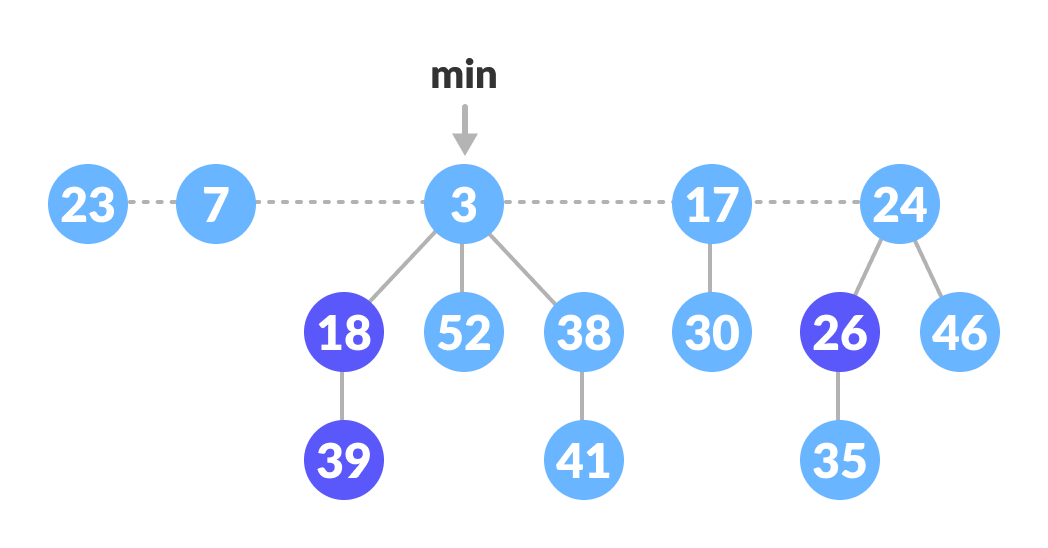
A fibonacci heap is a data structure that consists of a collection of trees which follow min heap or max heap property. We have already discussed min heap and max heap property in the Heap Data Structure article. These two properties are the characteristics of the trees present on a fibonacci heap.
In a fibonacci heap, a node can have more than two children or no children at all. Also, it has more efficient heap operations than that supported by the binomial and binary heaps.
The fibonacci heap is called a fibonacci heap because the trees are constructed in a way such that a tree of order n has at least Fn+2 nodes in it, where Fn+2 is the (n + 2)th Fibonacci number.
Properties of a Fibonacci Heap
Important properties of a Fibonacci heap are:
- It is a set of min heap-ordered trees. (i.e. The parent is always smaller than the children.)
- A pointer is maintained at the minimum element node.
- It consists of a set of marked nodes. (Decrease key operation)
- The trees within a Fibonacci heap are unordered but rooted.
Memory Representation of the Nodes in a Fibonacci Heap
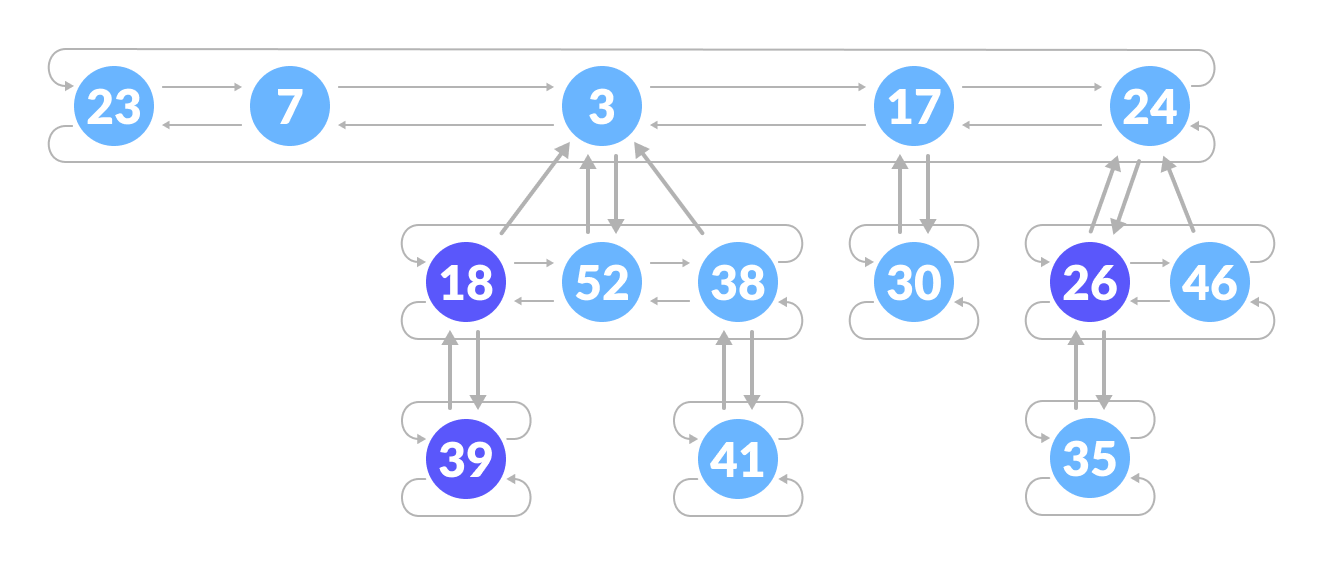
The roots of all the trees are linked together for faster access. The child nodes of a parent node are connected to each other through a circular doubly linked list as shown below.
There are two main advantages of using a circular doubly linked list.
- Deleting a node from the tree takes
O(1)time. - The concatenation of two such lists takes
O(1)time.
Operations on a Fibonacci Heap
Insertion
Algorithm
insert(H, x)
    degree[x] = 0
    p[x] = NIL
    child[x] = NIL
    left[x] = x
    right[x] = x
    mark[x] = FALSE
    concatenate the root list containing x with root list H
    if min[H] == NIL or key[x] < key[min[H]]
        then min[H] = x
    n[H] = n[H] + 1
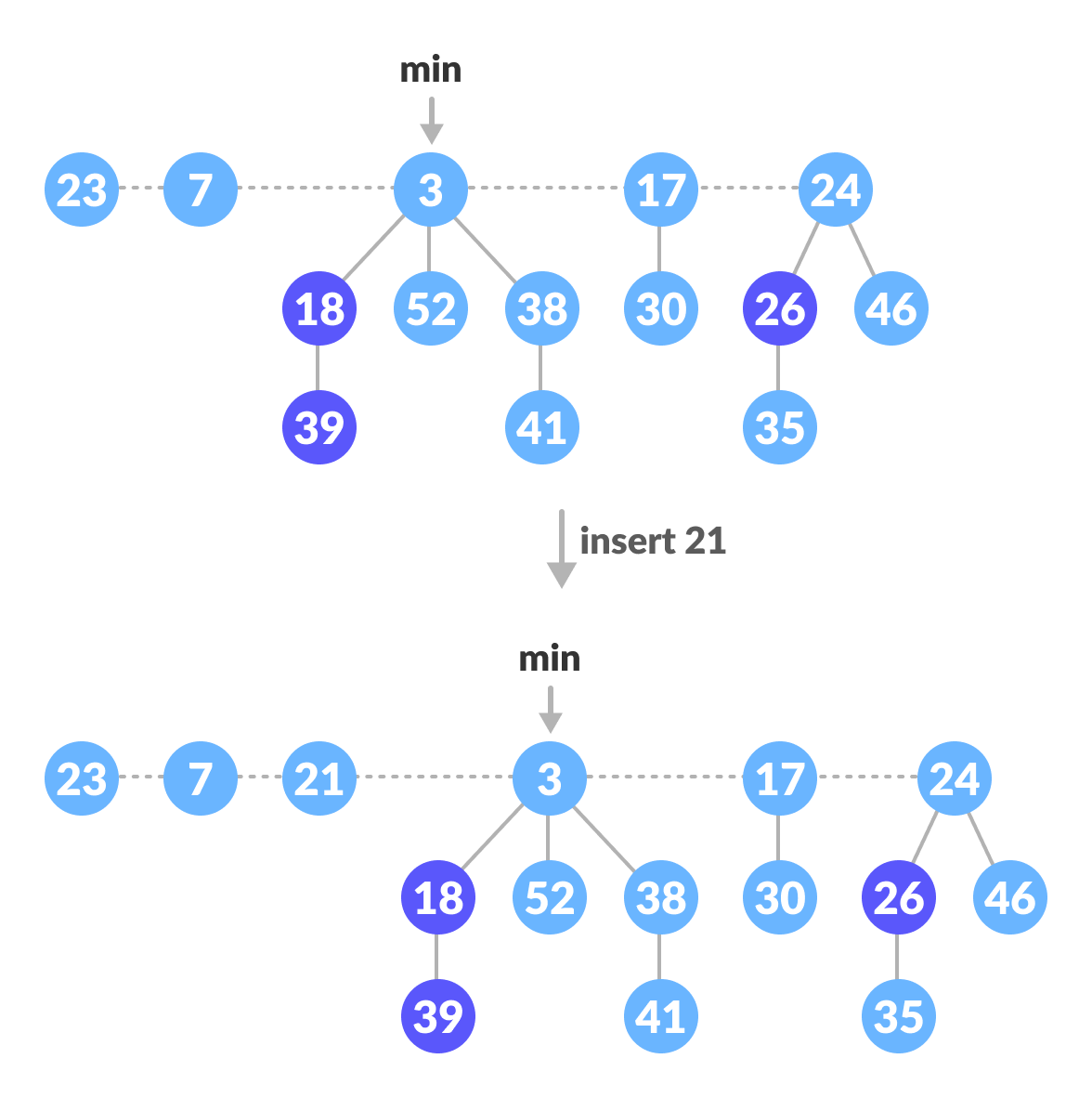
Inserting a node into an already existing heap follows the steps below.
- Create a new node for the element.
- Check if the heap is empty.
- If the heap is empty, set the new node as a root node and mark it min.
- Else, insert the node into the root list and update min.
Find Min
The minimum element is always given by the min pointer.
Union
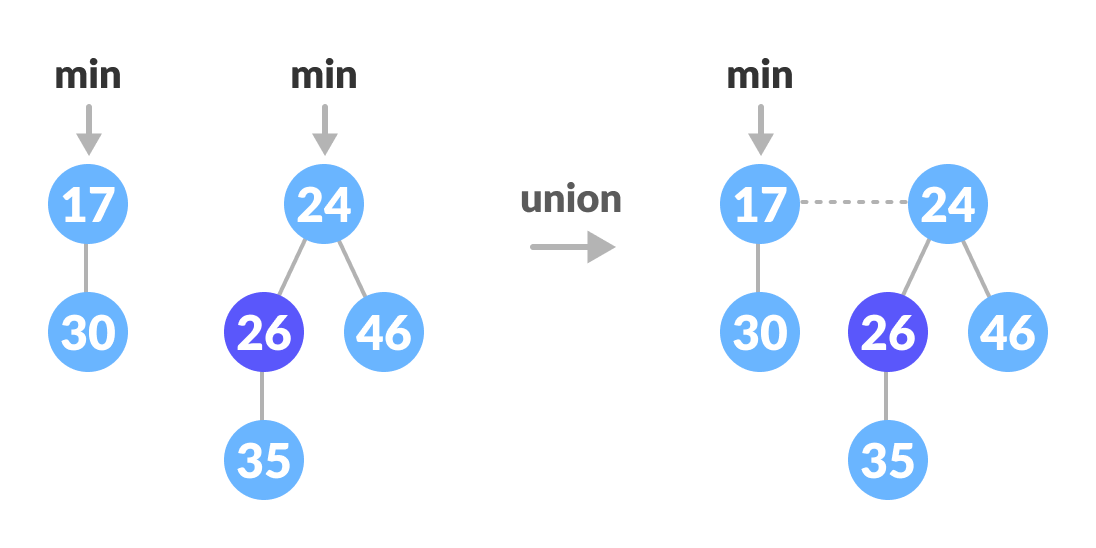
Union of two fibonacci heaps consists of following steps.
- Concatenate the roots of both the heaps.
- Update min by selecting a minimum key from the new root lists.
Extract Min
It is the most important operation on a fibonacci heap. In this operation, the node with minimum value is removed from the heap and the tree is re-adjusted.
The following steps are followed:
- Delete the min node.
- Set the min-pointer to the next root in the root list.
- Create an array of size equal to the maximum degree of the trees in the heap before deletion.
- Do the following (steps 5-7) until there are no multiple roots with the same degree.
- Map the degree of current root (min-pointer) to the degree in the array.
- Map the degree of next root to the degree in array.
- If there are more than two mappings for the same degree, then apply union operation to those roots such that the min-heap property is maintained (i.e. the minimum is at the root).
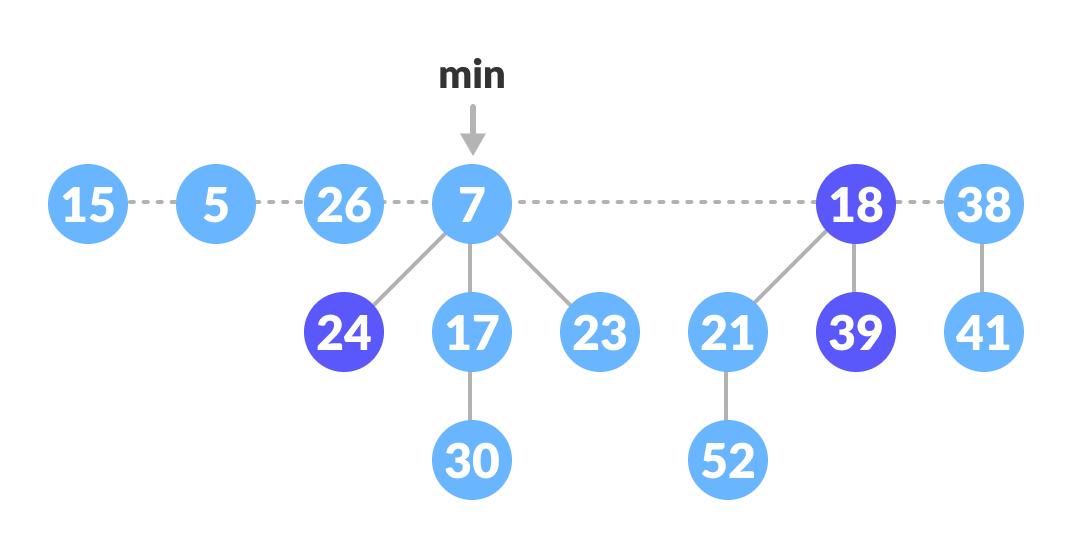
An implementation of the above steps can be understood in the example below.
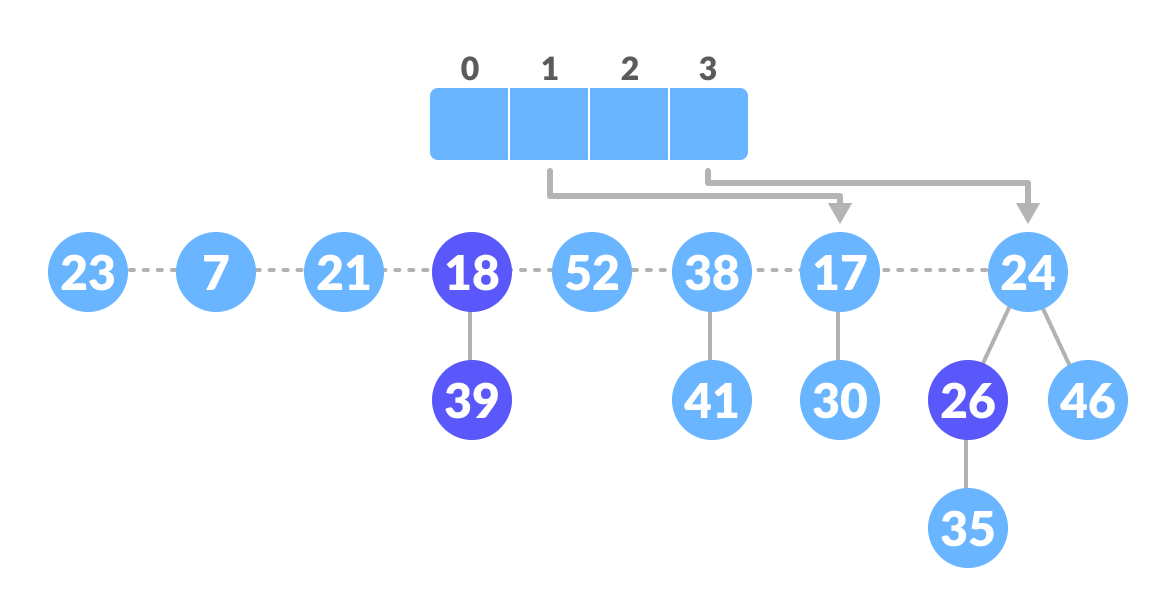
- We will perform an extract-min operation on the heap below.
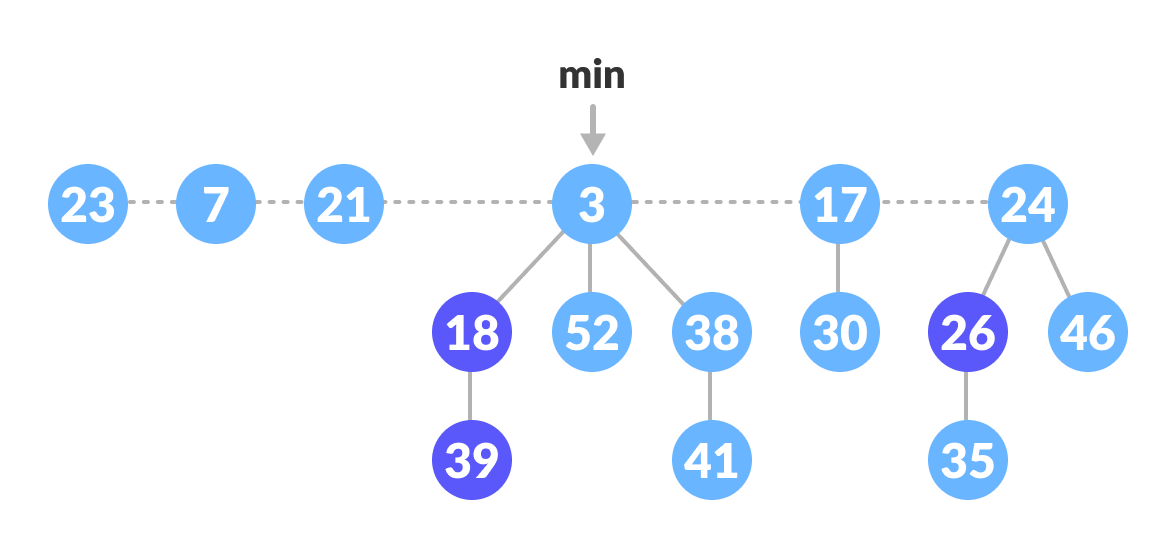
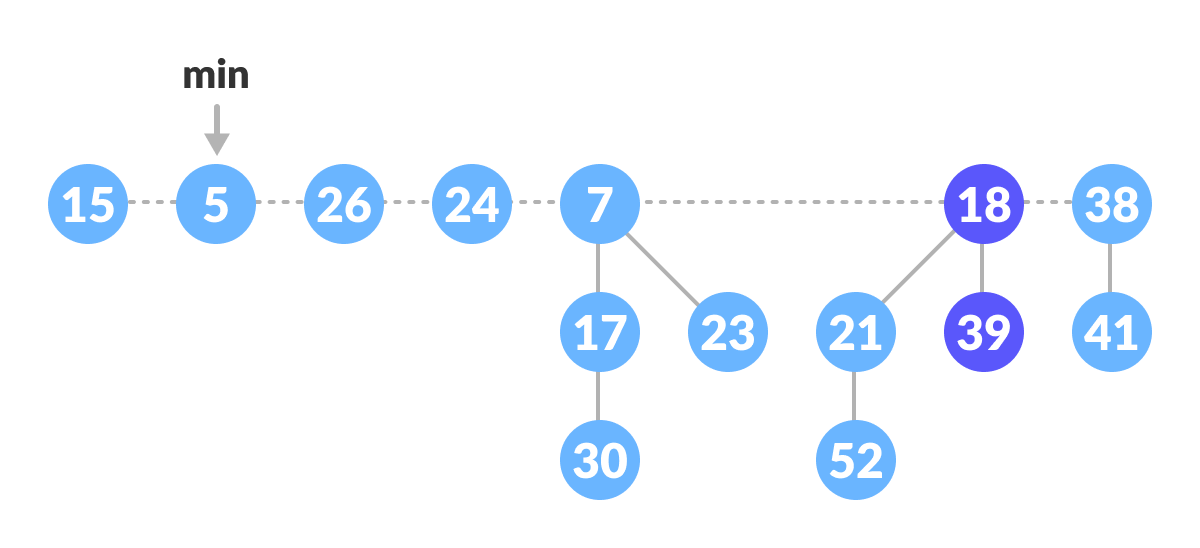
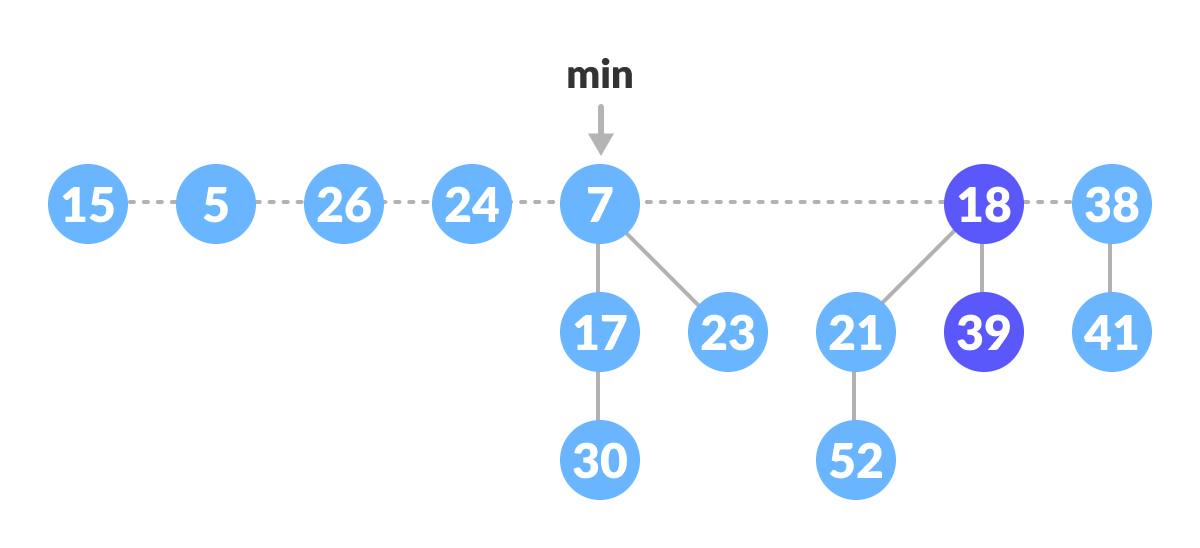
Fibonacci Heap - Delete the min node, add all its child nodes to the root list and set the min-pointer to the next root in the root list.
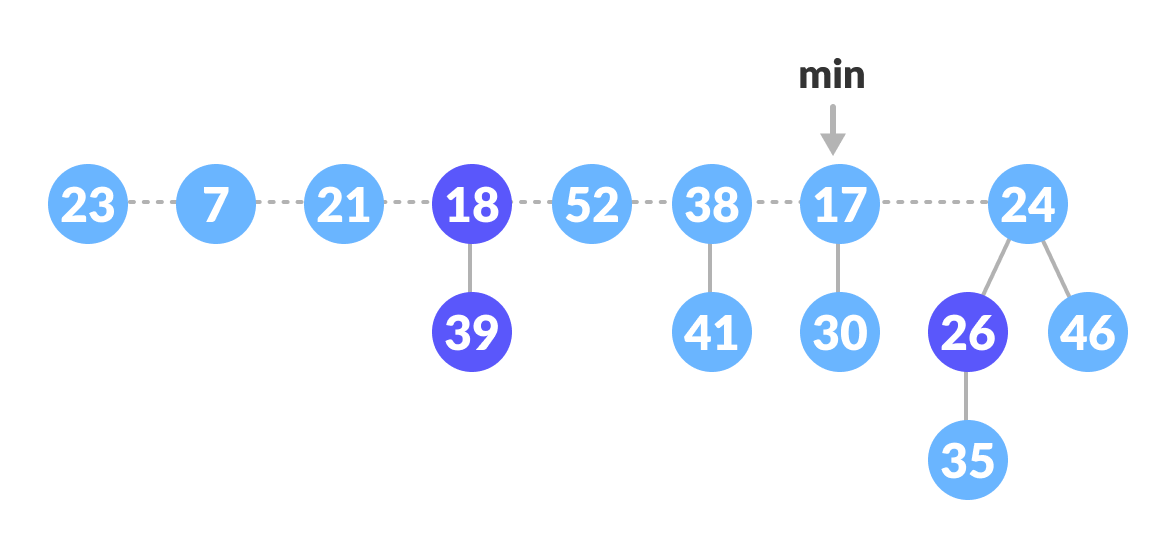
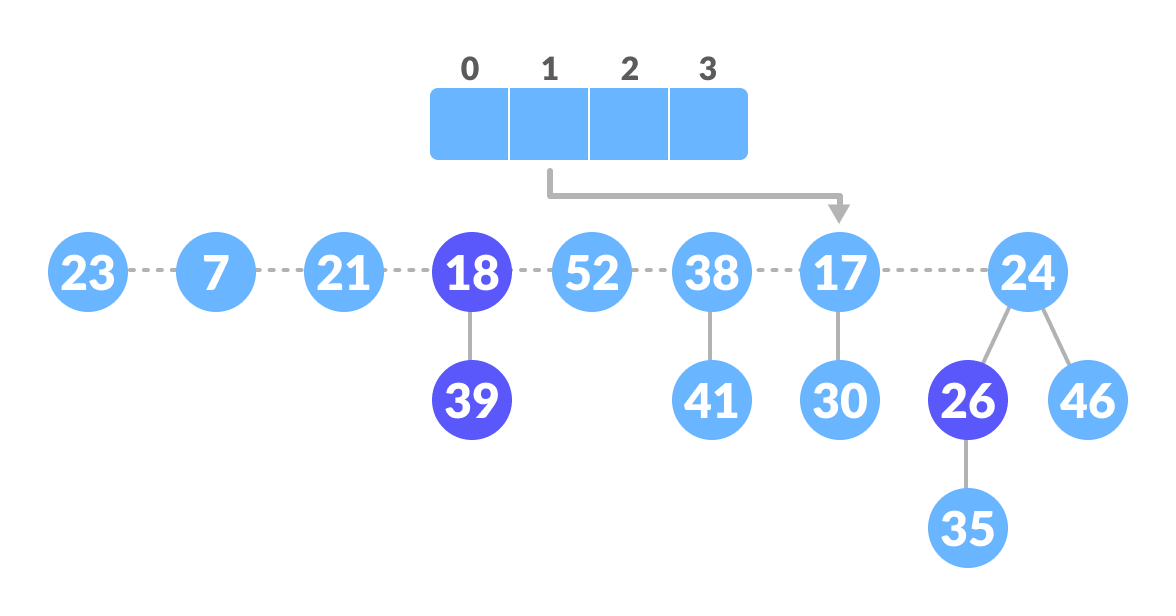
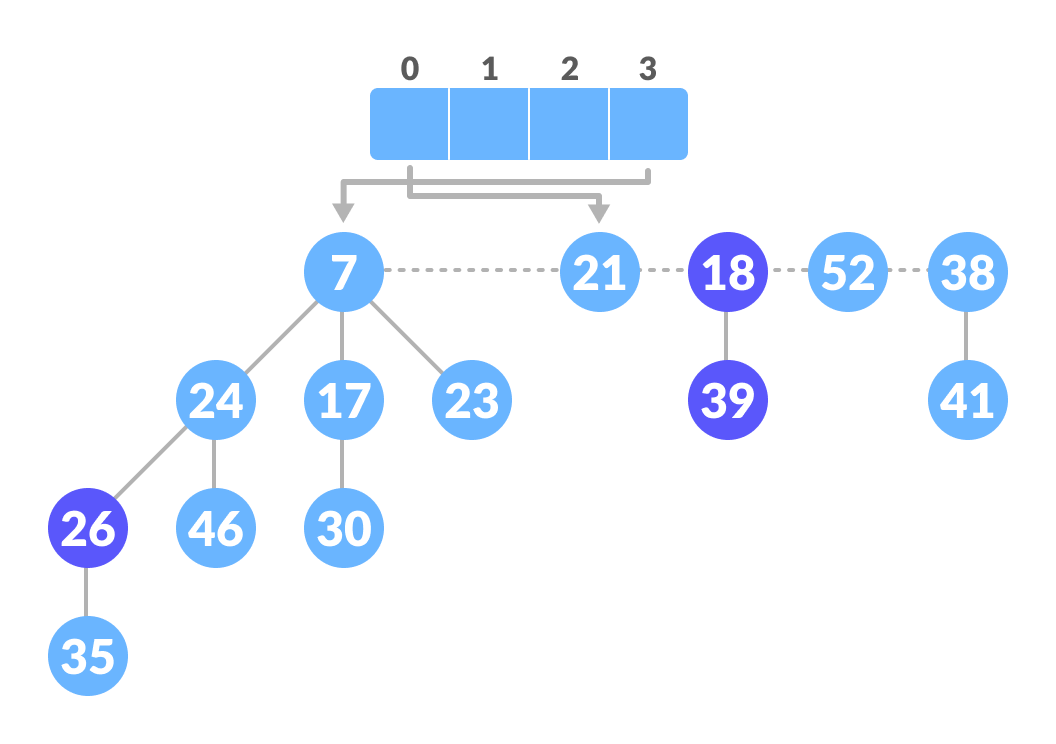
Delete the min node - The maximum degree in the tree is 3. Create an array of size 4 and map degree of the next roots with the array.
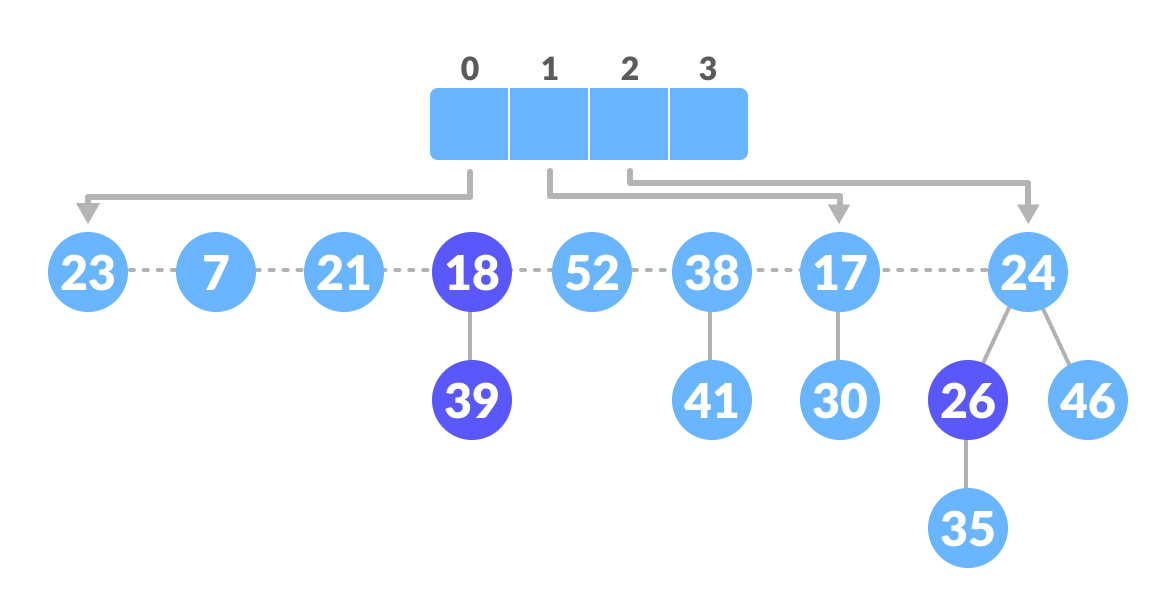
Create an array - Here, 23 and 7 have the same degrees, so unite them.
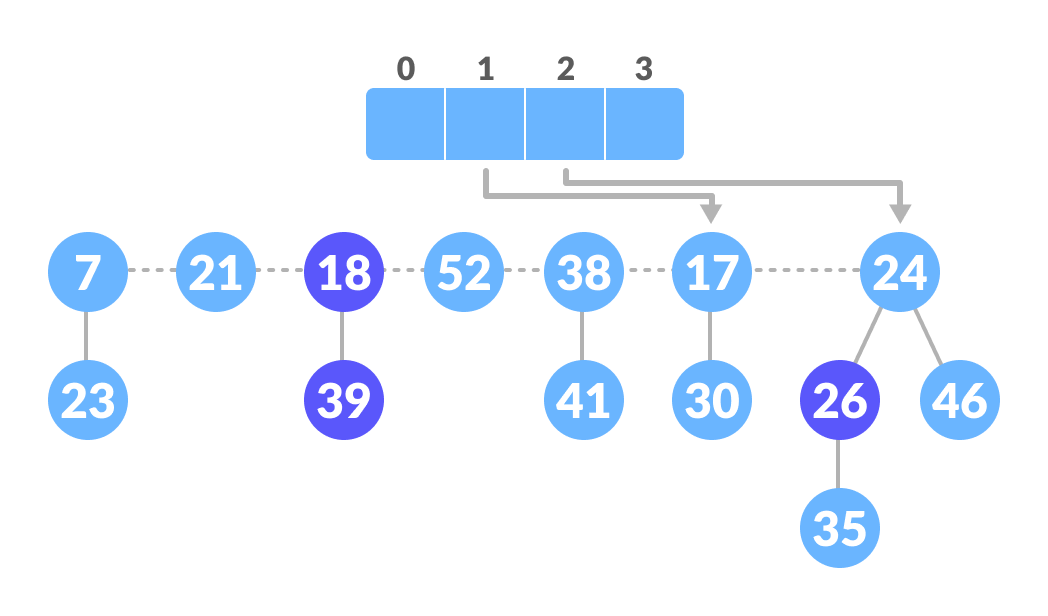
Unite those having the same degrees - Again, 7 and 17 have the same degrees, so unite them as well.
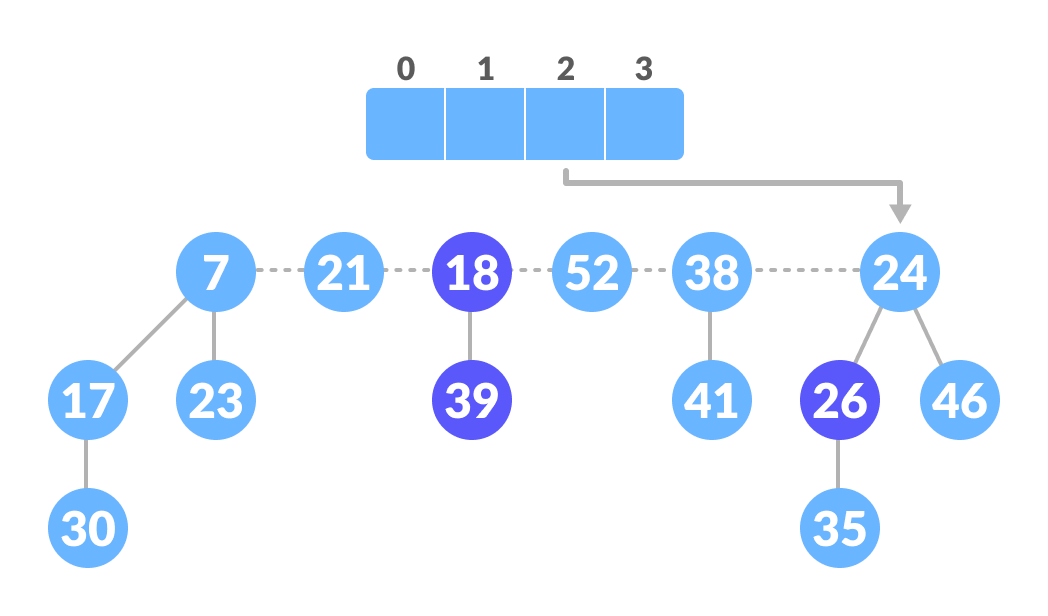
Unite those having the same degrees - Again 7 and 24 have the same degree, so unite them.
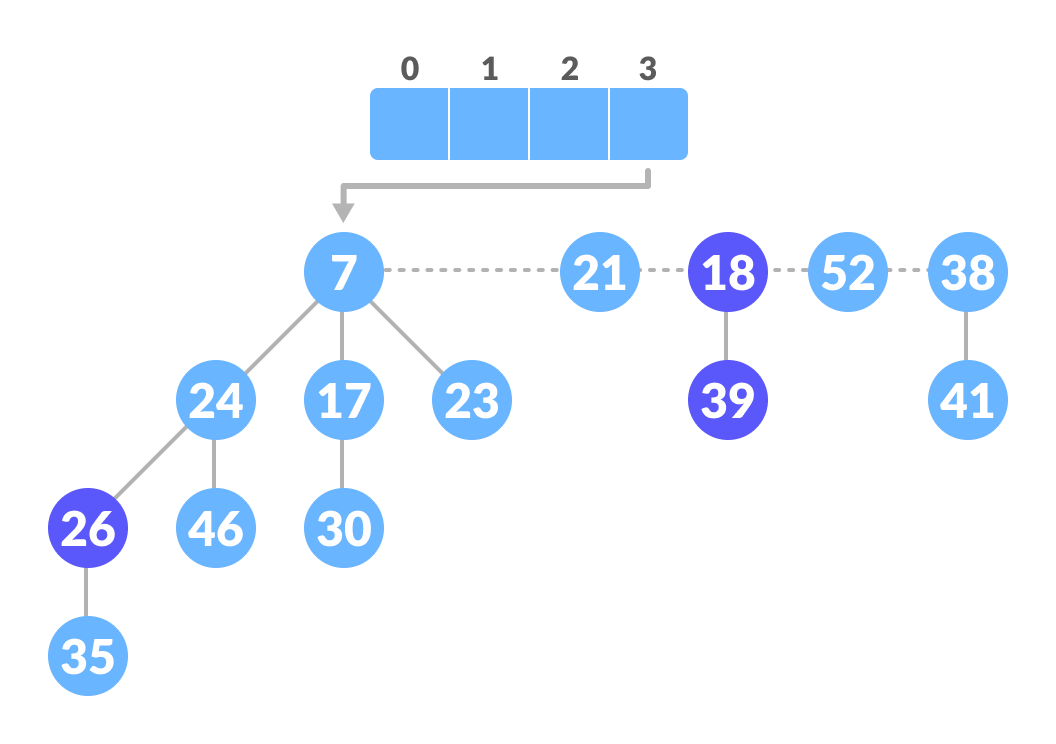
Unite those having the same degrees - Map the next nodes.
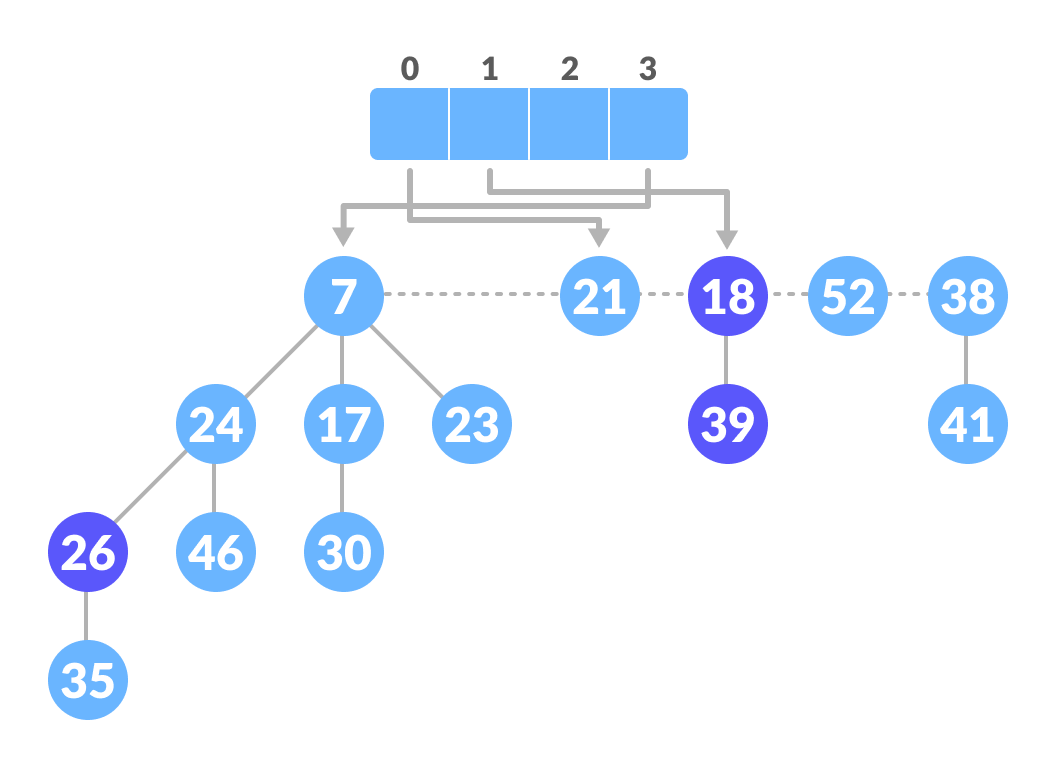
Map the remaining nodes - Again, 52 and 21 have the same degree, so unite them
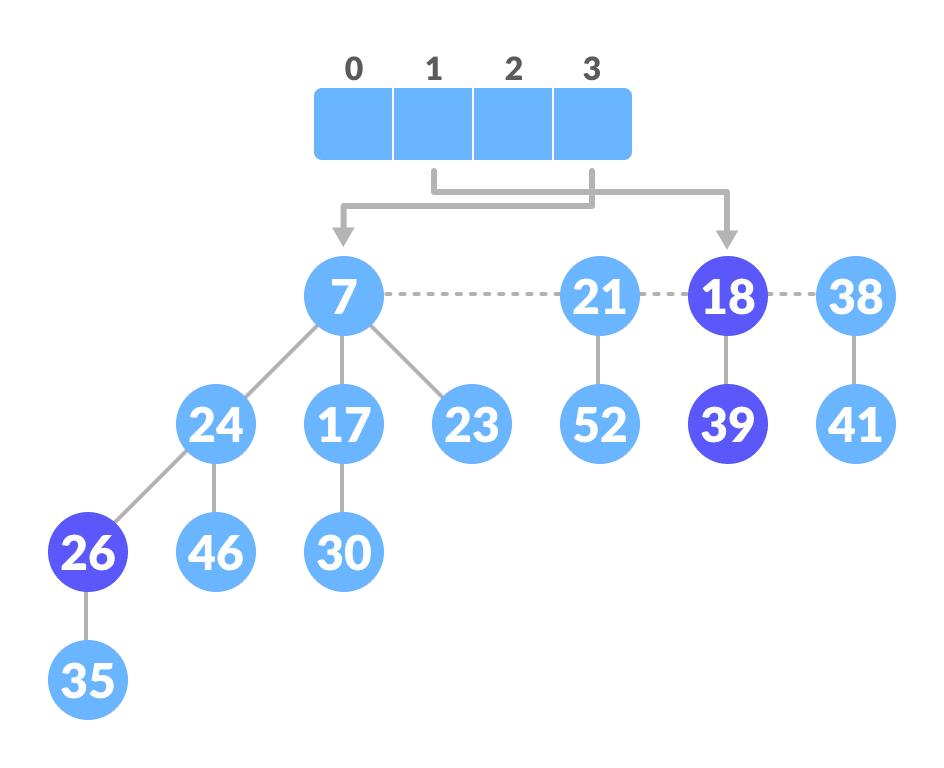
Unite those having the same degrees - Similarly, unite 21 and 18.
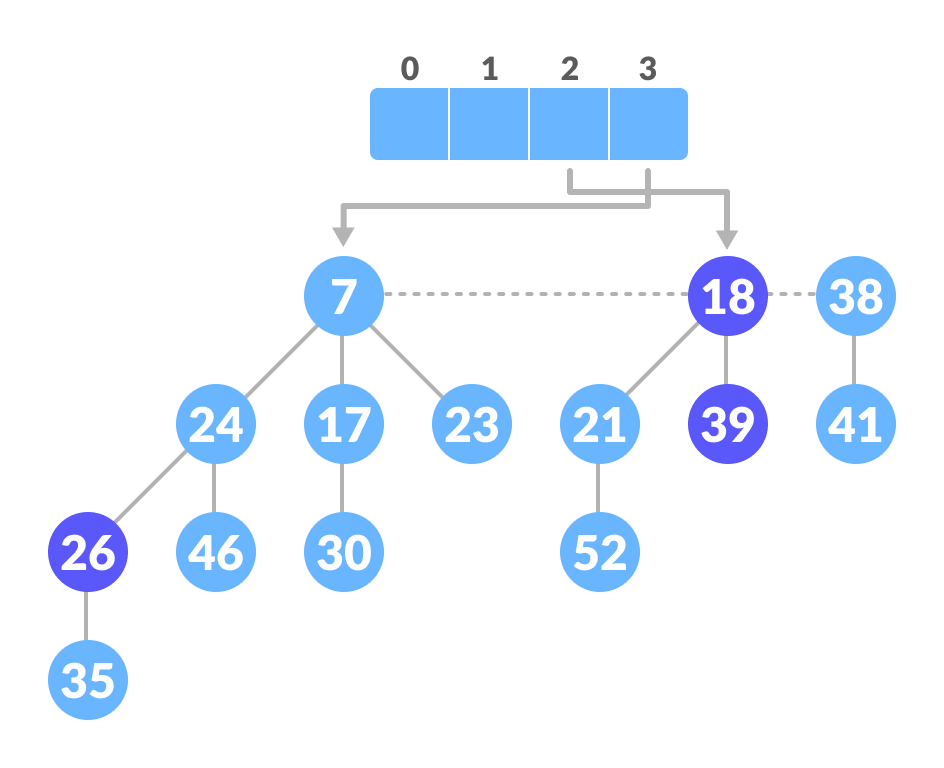
Unite those having the same degrees - Map the remaining root.
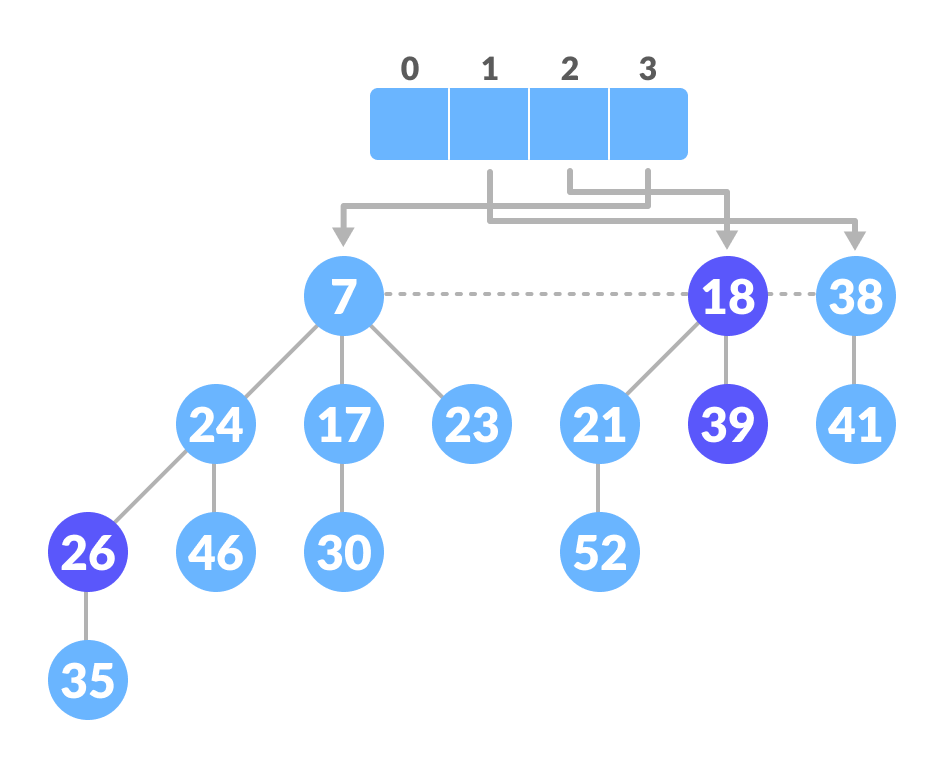
Map the remaining nodes - The final heap is.
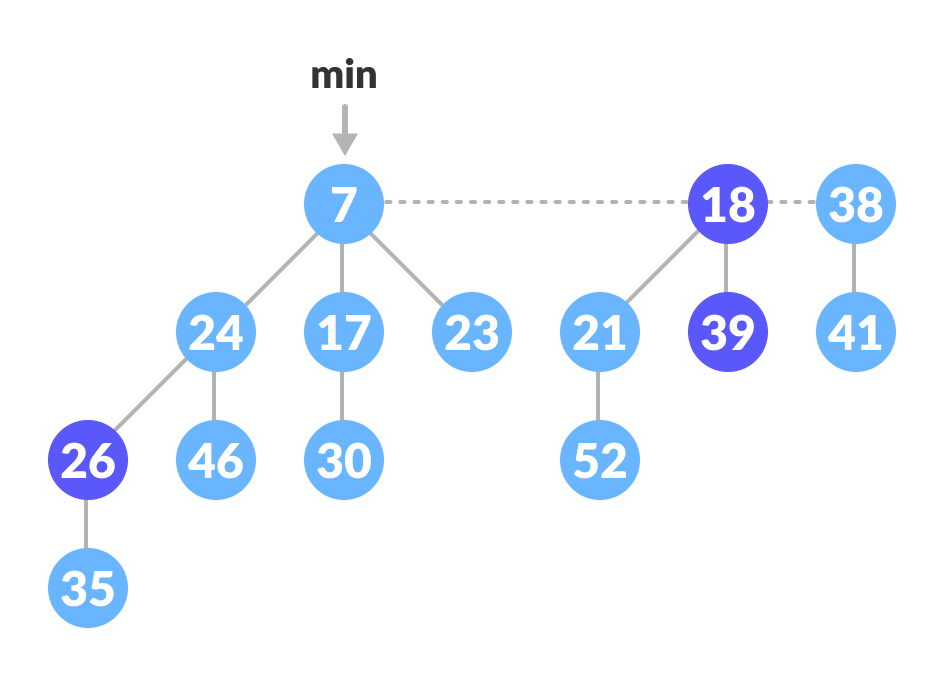
Final fibonacci heap
Decreasing a Key and Deleting a Node
These are the most important operations which are discussed in Decrease Key and Delete Node Operations.
Python, Java and C/C++ Examples
# Fibonacci Heap in python

import math

# Creating fibonacci tree
class FibonacciTree:
    def __init__(self, value):
        self.value = value
        self.child = []
        self.order = 0

    # Adding tree at the end of the tree
    def add_at_end(self, t):
        self.child.append(t)
        self.order = self.order + 1


# Creating Fibonacci heap
class FibonacciHeap:
    def __init__(self):
        self.trees = []
        self.least = None
        self.count = 0

    # Insert a node
    def insert_node(self, value):
        new_tree = FibonacciTree(value)
        self.trees.append(new_tree)
        if (self.least is None or value < self.least.value):
            self.least = new_tree
        self.count = self.count + 1

    # Get minimum value
    def get_min(self):
        if self.least is None:
            return None
        return self.least.value

    # Extract the minimum value
    def extract_min(self):
        smallest = self.least
        if smallest is not None:
            for child in smallest.child:
                self.trees.append(child)
            self.trees.remove(smallest)
            if self.trees == []:
                self.least = None
            else:
                self.least = self.trees[0]
                self.consolidate()
            self.count = self.count - 1
            return smallest.value

    # Consolidate the tree
    def consolidate(self):
        aux = (floor_log(self.count) + 1) * [None]

        while self.trees != []:
            x = self.trees[0]
            order = x.order
            self.trees.remove(x)
            while aux[order] is not None:
                y = aux[order]
                if x.value > y.value:
                    x, y = y, x
                x.add_at_end(y)
                aux[order] = None
                order = order + 1
            aux[order] = x

        self.least = None
        for k in aux:
            if k is not None:
                self.trees.append(k)
                if (self.least is None
                        or k.value < self.least.value):
                    self.least = k


def floor_log(x):
    return math.frexp(x)[1] - 1


fibonacci_heap = FibonacciHeap()

fibonacci_heap.insert_node(7)
fibonacci_heap.insert_node(3)
fibonacci_heap.insert_node(17)
fibonacci_heap.insert_node(24)

print('the minimum value of the fibonacci heap: {}'.format(fibonacci_heap.get_min()))

print('the minimum value removed: {}'.format(fibonacci_heap.extract_min()))
// Operations on Fibonacci Heap in Java

// Node creation
class node {
  node parent;
  node left;
  node right;
  node child;
  int degree;
  boolean mark;
  int key;

  public node() {
    this.degree = 0;
    this.mark = false;
    this.parent = null;
    this.left = this;
    this.right = this;
    this.child = null;
    this.key = Integer.MAX_VALUE;
  }

  node(int x) {
    this();
    this.key = x;
  }

  void set_parent(node x) {
    this.parent = x;
  }

  node get_parent() {
    return this.parent;
  }

  void set_left(node x) {
    this.left = x;
  }

  node get_left() {
    return this.left;
  }

  void set_right(node x) {
    this.right = x;
  }

  node get_right() {
    return this.right;
  }

  void set_child(node x) {
    this.child = x;
  }

  node get_child() {
    return this.child;
  }

  void set_degree(int x) {
    this.degree = x;
  }

  int get_degree() {
    return this.degree;
  }

  void set_mark(boolean m) {
    this.mark = m;
  }

  boolean get_mark() {
    return this.mark;
  }

  void set_key(int x) {
    this.key = x;
  }

  int get_key() {
    return this.key;
  }
}

public class fibHeap {
  node min;
  int n;
  boolean trace;
  node found;

  public boolean get_trace() {
    return trace;
  }

  public void set_trace(boolean t) {
    this.trace = t;
  }

  public static fibHeap create_heap() {
    return new fibHeap();
  }

  fibHeap() {
    min = null;
    n = 0;
    trace = false;
  }

  private void insert(node x) {
    if (min == null) {
      min = x;
      x.set_left(min);
      x.set_right(min);
    } else {
      x.set_right(min);
      x.set_left(min.get_left());
      min.get_left().set_right(x);
      min.set_left(x);
      if (x.get_key() < min.get_key())
        min = x;
    }
    n += 1;
  }

  public void insert(int key) {
    insert(new node(key));
  }

  public void display() {
    display(min);
    System.out.println();
  }

  private void display(node c) {
    System.out.print("(");
    if (c == null) {
      System.out.print(")");
      return;
    } else {
      node temp = c;
      do {
        System.out.print(temp.get_key());
        node k = temp.get_child();
        display(k);
        System.out.print("->");
        temp = temp.get_right();
      } while (temp != c);
      System.out.print(")");
    }
  }

  public static void merge_heap(fibHeap H1, fibHeap H2, fibHeap H3) {
    H3.min = H1.min;

    if (H1.min != null && H2.min != null) {
      node t1 = H1.min.get_left();
      node t2 = H2.min.get_left();
      H1.min.set_left(t2);
      t1.set_right(H2.min);
      H2.min.set_left(t1);
      t2.set_right(H1.min);
    }
    if (H1.min == null || (H2.min != null && H2.min.get_key() < H1.min.get_key()))
      H3.min = H2.min;
    H3.n = H1.n + H2.n;
  }

  public int find_min() {
    return this.min.get_key();
  }

  private void display_node(node z) {
    System.out.println("right: " + ((z.get_right() == null) ? "-1" : z.get_right().get_key()));
    System.out.println("left: " + ((z.get_left() == null) ? "-1" : z.get_left().get_key()));
    System.out.println("child: " + ((z.get_child() == null) ? "-1" : z.get_child().get_key()));
    System.out.println("degree " + z.get_degree());
  }

  public int extract_min() {
    node z = this.min;
    if (z != null) {
      node c = z.get_child();
      node k = c, p;
      if (c != null) {
        do {
          p = c.get_right();
          insert(c);
          c.set_parent(null);
          c = p;
        } while (c != null && c != k);
      }
      z.get_left().set_right(z.get_right());
      z.get_right().set_left(z.get_left());
      z.set_child(null);
      if (z == z.get_right())
        this.min = null;
      else {
        this.min = z.get_right();
        this.consolidate();
      }
      this.n -= 1;
      return z.get_key();
    }
    return Integer.MAX_VALUE;
  }

  public void consolidate() {
    double phi = (1 + Math.sqrt(5)) / 2;
    int Dofn = (int) (Math.log(this.n) / Math.log(phi));
    node[] A = new node[Dofn + 1];
    for (int i = 0; i <= Dofn; ++i)
      A[i] = null;
    node w = min;
    if (w != null) {
      node check = min;
      do {
        node x = w;
        int d = x.get_degree();
        while (A[d] != null) {
          node y = A[d];
          if (x.get_key() > y.get_key()) {
            node temp = x;
            x = y;
            y = temp;
            w = x;
          }
          fib_heap_link(y, x);
          check = x;
          A[d] = null;
          d += 1;
        }
        A[d] = x;
        w = w.get_right();
      } while (w != null && w != check);
      this.min = null;
      for (int i = 0; i <= Dofn; ++i) {
        if (A[i] != null) {
          insert(A[i]);
        }
      }
    }
  }

  // Linking operation
  private void fib_heap_link(node y, node x) {
    y.get_left().set_right(y.get_right());
    y.get_right().set_left(y.get_left());

    node p = x.get_child();
    if (p == null) {
      y.set_right(y);
      y.set_left(y);
    } else {
      y.set_right(p);
      y.set_left(p.get_left());
      p.get_left().set_right(y);
      p.set_left(y);
    }
    y.set_parent(x);
    x.set_child(y);
    x.set_degree(x.get_degree() + 1);
    y.set_mark(false);
  }

  // Search operation
  private void find(int key, node c) {
    if (found != null || c == null)
      return;
    else {
      node temp = c;
      do {
        if (key == temp.get_key())
          found = temp;
        else {
          node k = temp.get_child();
          find(key, k);
          temp = temp.get_right();
        }
      } while (temp != c && found == null);
    }
  }

  public node find(int k) {
    found = null;
    find(k, this.min);
    return found;
  }

  public void decrease_key(int key, int nval) {
    node x = find(key);
    decrease_key(x, nval);
  }

  // Decrease key operation
  private void decrease_key(node x, int k) {
    if (k > x.get_key())
      return;
    x.set_key(k);
    node y = x.get_parent();
    if (y != null && x.get_key() < y.get_key()) {
      cut(x, y);
      cascading_cut(y);
    }
    if (x.get_key() < min.get_key())
      min = x;
  }

  // Cut operation
  private void cut(node x, node y) {
    x.get_right().set_left(x.get_left());
    x.get_left().set_right(x.get_right());

    y.set_degree(y.get_degree() - 1);

    x.set_right(null);
    x.set_left(null);
    insert(x);
    x.set_parent(null);
    x.set_mark(false);
  }

  private void cascading_cut(node y) {
    node z = y.get_parent();
    if (z != null) {
      if (y.get_mark() == false)
        y.set_mark(true);
      else {
        cut(y, z);
        cascading_cut(z);
      }
    }
  }

  // Delete operations
  public void delete(node x) {
    decrease_key(x, Integer.MIN_VALUE);
    int p = extract_min();
  }

  public static void main(String[] args) {
    fibHeap obj = create_heap();
    obj.insert(7);
    obj.insert(26);
    obj.insert(30);
    obj.insert(39);
    obj.insert(10);
    obj.display();

    System.out.println(obj.extract_min());
    obj.display();
    System.out.println(obj.extract_min());
    obj.display();
    System.out.println(obj.extract_min());
    obj.display();
    System.out.println(obj.extract_min());
    obj.display();
    System.out.println(obj.extract_min());
    obj.display();
  }
}
// Operations on a Fibonacci heap in C

#include <math.h>
#include <stdbool.h>
#include <stdio.h>
#include <stdlib.h>

typedef struct _NODE {
  int key;
  int degree;
  struct _NODE *left_sibling;
  struct _NODE *right_sibling;
  struct _NODE *parent;
  struct _NODE *child;
  bool mark;
  bool visited;
} NODE;

typedef struct fibanocci_heap {
  int n;
  NODE *min;
  int phi;
  int degree;
} FIB_HEAP;

FIB_HEAP *make_fib_heap();
void insertion(FIB_HEAP *H, NODE *new, int val);
NODE *extract_min(FIB_HEAP *H);
void consolidate(FIB_HEAP *H);
void fib_heap_link(FIB_HEAP *H, NODE *y, NODE *x);
NODE *find_min_node(FIB_HEAP *H);
void decrease_key(FIB_HEAP *H, NODE *node, int key);
void cut(FIB_HEAP *H, NODE *node_to_be_decrease, NODE *parent_node);
void cascading_cut(FIB_HEAP *H, NODE *parent_node);
void Delete_Node(FIB_HEAP *H, int dec_key);

FIB_HEAP *make_fib_heap() {
  FIB_HEAP *H;
  H = (FIB_HEAP *)malloc(sizeof(FIB_HEAP));
  H->n = 0;
  H->min = NULL;
  H->phi = 0;
  H->degree = 0;
  return H;
}

// Printing the heap
void print_heap(NODE *n) {
  NODE *x;
  for (x = n;; x = x->right_sibling) {
    if (x->child == NULL) {
      printf("node with no child (%d) \n", x->key);
    } else {
      printf("NODE(%d) with child (%d)\n", x->key, x->child->key);
      print_heap(x->child);
    }
    if (x->right_sibling == n) {
      break;
    }
  }
}

// Inserting nodes
void insertion(FIB_HEAP *H, NODE *new, int val) {
  new = (NODE *)malloc(sizeof(NODE));
  new->key = val;
  new->degree = 0;
  new->mark = false;
  new->parent = NULL;
  new->child = NULL;
  new->visited = false;
  new->left_sibling = new;
  new->right_sibling = new;
  if (H->min == NULL) {
    H->min = new;
  } else {
    H->min->left_sibling->right_sibling = new;
    new->right_sibling = H->min;
    new->left_sibling = H->min->left_sibling;
    H->min->left_sibling = new;
    if (new->key < H->min->key) {
      H->min = new;
    }
  }
  (H->n)++;
}

// Find min node
NODE *find_min_node(FIB_HEAP *H) {
  if (H == NULL) {
    printf(" \n Fibonacci heap not yet created \n");
    return NULL;
  } else
    return H->min;
}

// Union operation
FIB_HEAP *unionHeap(FIB_HEAP *H1, FIB_HEAP *H2) {
  FIB_HEAP *Hnew;
  Hnew = make_fib_heap();
  Hnew->min = H1->min;

  NODE *temp1, *temp2;
  temp1 = Hnew->min->right_sibling;
  temp2 = H2->min->left_sibling;

  Hnew->min->right_sibling->left_sibling = H2->min->left_sibling;
  Hnew->min->right_sibling = H2->min;
  H2->min->left_sibling = Hnew->min;
  temp2->right_sibling = temp1;

  if ((H1->min == NULL) || (H2->min != NULL && H2->min->key < H1->min->key))
    Hnew->min = H2->min;
  Hnew->n = H1->n + H2->n;
  return Hnew;
}

// Calculate the degree
int cal_degree(int n) {
  int count = 0;
  while (n > 0) {
    n = n / 2;
    count++;
  }
  return count;
}

// Consolidate function
void consolidate(FIB_HEAP *H) {
  int degree, i, d;
  degree = cal_degree(H->n);
  NODE *A[degree], *x, *y, *z;
  for (i = 0; i <= degree; i++) {
    A[i] = NULL;
  }
  x = H->min;
  do {
    d = x->degree;
    while (A[d] != NULL) {
      y = A[d];
      if (x->key > y->key) {
        NODE *exchange_help;
        exchange_help = x;
        x = y;
        y = exchange_help;
      }
      if (y == H->min)
        H->min = x;
      fib_heap_link(H, y, x);
      if (y->right_sibling == x)
        H->min = x;
      A[d] = NULL;
      d++;
    }
    A[d] = x;
    x = x->right_sibling;
  } while (x != H->min);

  H->min = NULL;
  for (i = 0; i < degree; i++) {
    if (A[i] != NULL) {
      A[i]->left_sibling = A[i];
      A[i]->right_sibling = A[i];
      if (H->min == NULL) {
        H->min = A[i];
      } else {
        H->min->left_sibling->right_sibling = A[i];
        A[i]->right_sibling = H->min;
        A[i]->left_sibling = H->min->left_sibling;
        H->min->left_sibling = A[i];
        if (A[i]->key < H->min->key) {
          H->min = A[i];
        }
      }
      if (H->min == NULL) {
        H->min = A[i];
      } else if (A[i]->key < H->min->key) {
        H->min = A[i];
      }
    }
  }
}

// Linking
void fib_heap_link(FIB_HEAP *H, NODE *y, NODE *x) {
  y->right_sibling->left_sibling = y->left_sibling;
  y->left_sibling->right_sibling = y->right_sibling;

  if (x->right_sibling == x)
    H->min = x;

  y->left_sibling = y;
  y->right_sibling = y;
  y->parent = x;

  if (x->child == NULL) {
    x->child = y;
  }
  y->right_sibling = x->child;
  y->left_sibling = x->child->left_sibling;
  x->child->left_sibling->right_sibling = y;
  x->child->left_sibling = y;
  if ((y->key) < (x->child->key))
    x->child = y;

  (x->degree)++;
}

// Extract min
NODE *extract_min(FIB_HEAP *H) {
  if (H->min == NULL)
    printf("\n The heap is empty");
  else {
    NODE *temp = H->min;
    NODE *pntr;
    pntr = temp;
    NODE *x = NULL;
    if (temp->child != NULL) {
      x = temp->child;
      do {
        pntr = x->right_sibling;
        (H->min->left_sibling)->right_sibling = x;
        x->right_sibling = H->min;
        x->left_sibling = H->min->left_sibling;
        H->min->left_sibling = x;
        if (x->key < H->min->key)
          H->min = x;
        x->parent = NULL;
        x = pntr;
      } while (pntr != temp->child);
    }

    (temp->left_sibling)->right_sibling = temp->right_sibling;
    (temp->right_sibling)->left_sibling = temp->left_sibling;
    H->min = temp->right_sibling;

    if (temp == temp->right_sibling && temp->child == NULL)
      H->min = NULL;
    else {
      H->min = temp->right_sibling;
      consolidate(H);
    }
    H->n = H->n - 1;
    return temp;
  }
  return H->min;
}

void cut(FIB_HEAP *H, NODE *node_to_be_decrease, NODE *parent_node) {
  NODE *temp_parent_check;

  if (node_to_be_decrease == node_to_be_decrease->right_sibling)
    parent_node->child = NULL;

  node_to_be_decrease->left_sibling->right_sibling = node_to_be_decrease->right_sibling;
  node_to_be_decrease->right_sibling->left_sibling = node_to_be_decrease->left_sibling;
  if (node_to_be_decrease == parent_node->child)
    parent_node->child = node_to_be_decrease->right_sibling;
  (parent_node->degree)--;

  node_to_be_decrease->left_sibling = node_to_be_decrease;
  node_to_be_decrease->right_sibling = node_to_be_decrease;
  H->min->left_sibling->right_sibling = node_to_be_decrease;
  node_to_be_decrease->right_sibling = H->min;
  node_to_be_decrease->left_sibling = H->min->left_sibling;
  H->min->left_sibling = node_to_be_decrease;

  node_to_be_decrease->parent = NULL;
  node_to_be_decrease->mark = false;
}

void cascading_cut(FIB_HEAP *H, NODE *parent_node) {
  NODE *aux;
  aux = parent_node->parent;
  if (aux != NULL) {
    if (parent_node->mark == false) {
      parent_node->mark = true;
    } else {
      cut(H, parent_node, aux);
      cascading_cut(H, aux);
    }
  }
}

void decrease_key(FIB_HEAP *H, NODE *node_to_be_decrease, int new_key) {
  NODE *parent_node;
  if (H == NULL) {
    printf("\n FIbonacci heap not created ");
    return;
  }
  if (node_to_be_decrease == NULL) {
    printf("Node is not in the heap");
  }

  else {
    if (node_to_be_decrease->key < new_key) {
      printf("\n Invalid new key for decrease key operation \n ");
    } else {
      node_to_be_decrease->key = new_key;
      parent_node = node_to_be_decrease->parent;
      if ((parent_node != NULL) && (node_to_be_decrease->key < parent_node->key)) {
        printf("\n cut called");
        cut(H, node_to_be_decrease, parent_node);
        printf("\n cascading cut called");
        cascading_cut(H, parent_node);
      }
      if (node_to_be_decrease->key < H->min->key) {
        H->min = node_to_be_decrease;
      }
    }
  }
}

void *find_node(FIB_HEAP *H, NODE *n, int key, int new_key) {
  NODE *find_use = n;
  NODE *f = NULL;
  find_use->visited = true;
  if (find_use->key == key) {
    find_use->visited = false;
    f = find_use;
    decrease_key(H, f, new_key);
  }
  if (find_use->child != NULL) {
    find_node(H, find_use->child, key, new_key);
  }
  if ((find_use->right_sibling->visited != true)) {
    find_node(H, find_use->right_sibling, key, new_key);
  }

  find_use->visited = false;
}

FIB_HEAP *insertion_procedure() {
  FIB_HEAP *temp;
  int no_of_nodes, ele, i;
  NODE *new_node;
  temp = (FIB_HEAP *)malloc(sizeof(FIB_HEAP));
  temp = NULL;
  if (temp == NULL) {
    temp = make_fib_heap();
  }
  printf(" \n enter number of nodes to be insert = ");
  scanf("%d", &no_of_nodes);
  for (i = 1; i <= no_of_nodes; i++) {
    printf("\n node %d and its key value = ", i);
    scanf("%d", &ele);
    insertion(temp, new_node, ele);
  }
  return temp;
}
void Delete_Node(FIB_HEAP *H, int dec_key) {
  NODE *p = NULL;
  find_node(H, H->min, dec_key, -5000);
  p = extract_min(H);
  if (p != NULL)
    printf("\n Node deleted");
  else
    printf("\n Node not deleted:some error");
}

int main(int argc, char **argv) {
  NODE *new_node, *min_node, *extracted_min, *node_to_be_decrease, *find_use;
  FIB_HEAP *heap, *h1, *h2;
  int operation_no, new_key, dec_key, ele, i, no_of_nodes;
  heap = (FIB_HEAP *)malloc(sizeof(FIB_HEAP));
  heap = NULL;
  while (1) {
    printf(" \n Operations \n 1. Create Fibonacci heap \n 2. Insert nodes into fibonacci heap \n 3. Find min \n 4. Union \n 5. Extract min \n 6. Decrease key \n 7.Delete node \n 8. print heap \n 9. exit \n enter operation_no = ");
    scanf("%d", &operation_no);

    switch (operation_no) {
      case 1:
        heap = make_fib_heap();
        break;

      case 2:
        if (heap == NULL) {
          heap = make_fib_heap();
        }
        printf(" enter number of nodes to be insert = ");
        scanf("%d", &no_of_nodes);
        for (i = 1; i <= no_of_nodes; i++) {
          printf("\n node %d and its key value = ", i);
          scanf("%d", &ele);
          insertion(heap, new_node, ele);
        }
        break;

      case 3:
        min_node = find_min_node(heap);
        if (min_node == NULL)
          printf("No minimum value");
        else
          printf("\n min value = %d", min_node->key);
        break;

      case 4:
        if (heap == NULL) {
          printf("\n no FIbonacci heap created \n ");
          break;
        }
        h1 = insertion_procedure();
        heap = unionHeap(heap, h1);
        printf("Unified Heap:\n");
        print_heap(heap->min);
        break;

      case 5:
        if (heap == NULL)
          printf("Empty Fibonacci heap");
        else {
          extracted_min = extract_min(heap);
          printf("\n min value = %d", extracted_min->key);
          printf("\n Updated heap: \n");
          print_heap(heap->min);
        }
        break;

      case 6:
        if (heap == NULL)
          printf("Fibonacci heap is empty");
        else {
          printf(" \n node to be decreased = ");
          scanf("%d", &dec_key);
          printf(" \n enter the new key = ");
          scanf("%d", &new_key);
          find_use = heap->min;
          find_node(heap, find_use, dec_key, new_key);
          printf("\n Key decreased- Corresponding heap:\n");
          print_heap(heap->min);
        }
        break;
      case 7:
        if (heap == NULL)
          printf("Fibonacci heap is empty");
        else {
          printf(" \n Enter node key to be deleted = ");
          scanf("%d", &dec_key);
          Delete_Node(heap, dec_key);
          printf("\n Node Deleted- Corresponding heap:\n");
          print_heap(heap->min);
          break;
        }
      case 8:
        print_heap(heap->min);
        break;

      case 9:
        free(new_node);
        free(heap);
        exit(0);

      default:
        printf("Invalid choice ");
    }
  }
}
// Operations on a Fibonacci heap in C++

#include <cmath>
#include <cstdlib>
#include <iostream>

using namespace std;

// Node creation
struct node {
  int n;
  int degree;
  node *parent;
  node *child;
  node *left;
  node *right;
  char mark;

  char C;
};

// Implementation of Fibonacci heap
class FibonacciHeap {
   private:
  int nH;

  node *H;

   public:
  node *InitializeHeap();
  int Fibonnaci_link(node *, node *, node *);
  node *Create_node(int);
  node *Insert(node *, node *);
  node *Union(node *, node *);
  node *Extract_Min(node *);
  int Consolidate(node *);
  int Display(node *);
  node *Find(node *, int);
  int Decrease_key(node *, int, int);
  int Delete_key(node *, int);
  int Cut(node *, node *, node *);
  int Cascase_cut(node *, node *);
  FibonacciHeap() { H = InitializeHeap(); }
};

// Initialize heap
node *FibonacciHeap::InitializeHeap() {
  node *np;
  np = NULL;
  return np;
}

// Create node
node *FibonacciHeap::Create_node(int value) {
  node *x = new node;
  x->n = value;
  return x;
}

// Insert node
node *FibonacciHeap::Insert(node *H, node *x) {
  x->degree = 0;
  x->parent = NULL;
  x->child = NULL;
  x->left = x;
  x->right = x;
  x->mark = 'F';
  x->C = 'N';
  if (H != NULL) {
    (H->left)->right = x;
    x->right = H;
    x->left = H->left;
    H->left = x;
    if (x->n < H->n)
      H = x;
  } else {
    H = x;
  }
  nH = nH + 1;
  return H;
}

// Create linking
int FibonacciHeap::Fibonnaci_link(node *H1, node *y, node *z) {
  (y->left)->right = y->right;
  (y->right)->left = y->left;
  if (z->right == z)
    H1 = z;
  y->left = y;
  y->right = y;
  y->parent = z;

  if (z->child == NULL)
    z->child = y;

  y->right = z->child;
  y->left = (z->child)->left;
  ((z->child)->left)->right = y;
  (z->child)->left = y;

  if (y->n < (z->child)->n)
    z->child = y;
  z->degree++;
}

// Union Operation
node *FibonacciHeap::Union(node *H1, node *H2) {
  node *np;
  node *H = InitializeHeap();
  H = H1;
  (H->left)->right = H2;
  (H2->left)->right = H;
  np = H->left;
  H->left = H2->left;
  H2->left = np;
  return H;
}

// Display the heap
int FibonacciHeap::Display(node *H) {
  node *p = H;
  if (p == NULL) {
    cout << "Empty Heap" << endl;
    return 0;
  }
  cout << "Root Nodes: " << endl;

  do {
    cout << p->n;
    p = p->right;
    if (p != H) {
      cout << "-->";
    }
  } while (p != H && p->right != NULL);
  cout << endl;
}

// Extract min
node *FibonacciHeap::Extract_Min(node *H1) {
  node *p;
  node *ptr;
  node *z = H1;
  p = z;
  ptr = z;
  if (z == NULL)
    return z;

  node *x;
  node *np;

  x = NULL;

  if (z->child != NULL)
    x = z->child;

  if (x != NULL) {
    ptr = x;
    do {
      np = x->right;
      (H1->left)->right = x;
      x->right = H1;
      x->left = H1->left;
      H1->left = x;
      if (x->n < H1->n)
        H1 = x;

      x->parent = NULL;
      x = np;
    } while (np != ptr);
  }

  (z->left)->right = z->right;
  (z->right)->left = z->left;
  H1 = z->right;

  if (z == z->right && z->child == NULL)
    H = NULL;

  else {
    H1 = z->right;
    Consolidate(H1);
  }
  nH = nH - 1;
  return p;
}

// Consolidation Function
int FibonacciHeap::Consolidate(node *H1) {
  int d, i;
  float f = (log(nH)) / (log(2));
  int D = f;
  node *A[D];

  for (i = 0; i <= D; i++)
    A[i] = NULL;

  node *x = H1;
  node *y;
  node *np;
  node *pt = x;

  do {
    pt = pt->right;

    d = x->degree;

    while (A[d] != NULL)

    {
      y = A[d];

      if (x->n > y->n)

      {
        np = x;

        x = y;

        y = np;
      }

      if (y == H1)
        H1 = x;
      Fibonnaci_link(H1, y, x);
      if (x->right == x)
        H1 = x;
      A[d] = NULL;
      d = d + 1;
    }

    A[d] = x;
    x = x->right;

  }

  while (x != H1);
  H = NULL;
  for (int j = 0; j <= D; j++) {
    if (A[j] != NULL) {
      A[j]->left = A[j];
      A[j]->right = A[j];
      if (H != NULL) {
        (H->left)->right = A[j];
        A[j]->right = H;
        A[j]->left = H->left;
        H->left = A[j];
        if (A[j]->n < H->n)
          H = A[j];
      } else {
        H = A[j];
      }
      if (H == NULL)
        H = A[j];
      else if (A[j]->n < H->n)
        H = A[j];
    }
  }
}

// Decrease Key Operation
int FibonacciHeap::Decrease_key(node *H1, int x, int k) {
  node *y;
  if (H1 == NULL) {
    cout << "The Heap is Empty" << endl;
    return 0;
  }
  node *ptr = Find(H1, x);
  if (ptr == NULL) {
    cout << "Node not found in the Heap" << endl;
    return 1;
  }

  if (ptr->n < k) {
    cout << "Entered key greater than current key" << endl;
    return 0;
  }
  ptr->n = k;
  y = ptr->parent;
  if (y != NULL && ptr->n < y->n) {
    Cut(H1, ptr, y);
    Cascase_cut(H1, y);
  }

  if (ptr->n < H->n)
    H = ptr;

  return 0;
}

// Cutting Function
int FibonacciHeap::Cut(node *H1, node *x, node *y)

{
  if (x == x->right)
    y->child = NULL;
  (x->left)->right = x->right;
  (x->right)->left = x->left;
  if (x == y->child)
    y->child = x->right;
  y->degree = y->degree - 1;
  x->right = x;
  x->left = x;
  (H1->left)->right = x;
  x->right = H1;
  x->left = H1->left;
  H1->left = x;
  x->parent = NULL;
  x->mark = 'F';
}

// Cascade cut
int FibonacciHeap::Cascase_cut(node *H1, node *y) {
  node *z = y->parent;
  if (z != NULL) {
    if (y->mark == 'F') {
      y->mark = 'T';
    } else

    {
      Cut(H1, y, z);
      Cascase_cut(H1, z);
    }
  }
}

// Search function
node *FibonacciHeap::Find(node *H, int k) {
  node *x = H;
  x->C = 'Y';
  node *p = NULL;
  if (x->n == k) {
    p = x;
    x->C = 'N';
    return p;
  }

  if (p == NULL) {
    if (x->child != NULL)
      p = Find(x->child, k);
    if ((x->right)->C != 'Y')
      p = Find(x->right, k);
  }

  x->C = 'N';
  return p;
}

// Deleting key
int FibonacciHeap::Delete_key(node *H1, int k) {
  node *np = NULL;
  int t;
  t = Decrease_key(H1, k, -5000);
  if (!t)
    np = Extract_Min(H);
  if (np != NULL)
    cout << "Key Deleted" << endl;
  else
    cout << "Key not Deleted" << endl;
  return 0;
}

int main() {
  int n, m, l;
  FibonacciHeap fh;
  node *p;
  node *H;
  H = fh.InitializeHeap();

  p = fh.Create_node(7);
  H = fh.Insert(H, p);
  p = fh.Create_node(3);
  H = fh.Insert(H, p);
  p = fh.Create_node(17);
  H = fh.Insert(H, p);
  p = fh.Create_node(24);
  H = fh.Insert(H, p);

  fh.Display(H);

  p = fh.Extract_Min(H);
  if (p != NULL)
    cout << "The node with minimum key: " << p->n << endl;
  else
    cout << "Heap is empty" << endl;

  m = 26;
  l = 16;
  fh.Decrease_key(H, m, l);

  m = 16;
  fh.Delete_key(H, m);
}
Complexities
| Insertion | O(1) |
| Find Min | O(1) |
| Union | O(1) |
| Extract Min | O(log n) |
| Decrease Key | O(1) |
| Delete Node | O(log n) |
Fibonacci Heap Applications
- To improve the asymptotic running time of Dijkstra's algorithm.