Greedy Algorithm
A greedy algorithm is an approach for solving a problem by selecting the best option available at the moment. It doesn't worry whether the current best result will bring the overall optimal result.
The algorithm never reverses the earlier decision even if the choice is wrong. It works in a top-down approach.
This algorithm may not produce the best result for all the problems. It's because it always goes for the local best choice to produce the global best result.
However, we can determine if the algorithm can be used with any problem if the problem has the following properties:
1. Greedy Choice Property
If an optimal solution to the problem can be found by choosing the best choice at each step without reconsidering the previous steps once chosen, the problem can be solved using a greedy approach. This property is called greedy choice property.
2. Optimal Substructure
If the optimal overall solution to the problem corresponds to the optimal solution to its subproblems, then the problem can be solved using a greedy approach. This property is called optimal substructure.
Advantages of Greedy Approach
- The algorithm is easier to describe.
- This algorithm can perform better than other algorithms (but, not in all cases).
Drawback of Greedy Approach
As mentioned earlier, the greedy algorithm doesn't always produce the optimal solution. This is the major disadvantage of the algorithm.
For example, suppose we want to find the longest path in the graph below from root to leaf. Let's use the greedy algorithm here.
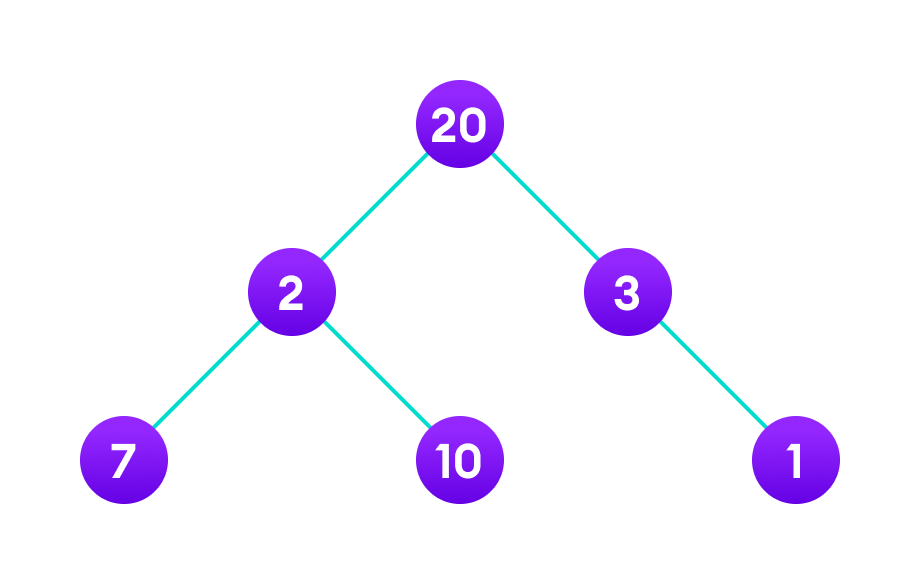
Greedy Approach
1. Let's start with the root node 20. The weight of the right child is 3 and the weight of the left child is 2.
2. Our problem is to find the largest path. And, the optimal solution at the moment is 3. So, the greedy algorithm will choose 3.
3. Finally the weight of an only child of 3 is 1. This gives us our final result 20 + 3 + 1 = 24.
However, it is not the optimal solution. There is another path that carries more weight (20 + 2 + 10 = 32) as shown in the image below.
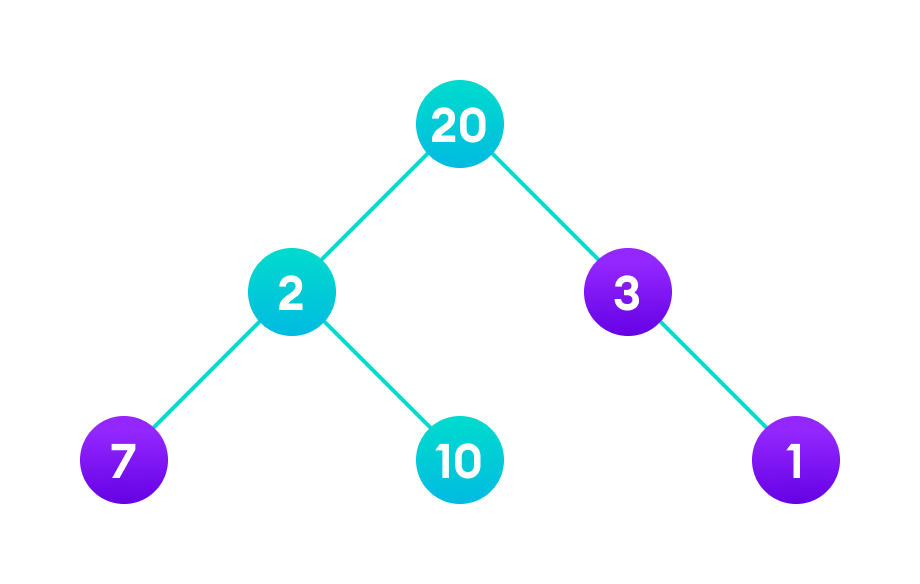
Therefore, greedy algorithms do not always give an optimal/feasible solution.
Greedy Algorithm
- To begin with, the solution set (containing answers) is empty.
- At each step, an item is added to the solution set until a solution is reached.
- If the solution set is feasible, the current item is kept.
- Else, the item is rejected and never considered again.
Let's now use this algorithm to solve a problem.
Example - Greedy Approach
Problem: You have to make a change of an amount using the smallest possible number of coins.
Amount: $18

Available coins are
  $5 coin
  $2 coin
  $1 coin
There is no limit to the number of each coin you can use.
Solution:
- Create an empty
solution-set = { }. Available coins are{5, 2, 1}. - We are supposed to find the
sum = 18. Let's start withsum = 0. - Always select the coin with the largest value (i.e. 5) until the
sum > 18. (When we select the largest value at each step, we hope to reach the destination faster. This concept is called greedy choice property.) - In the first iteration,
solution-set = {5}andsum = 5. - In the second iteration,
solution-set = {5, 5}andsum = 10. - In the third iteration,
solution-set = {5, 5, 5}andsum = 15. - In the fourth iteration,
solution-set = {5, 5, 5, 2}andsum = 17. (We cannot select 5 here because if we do so,sum = 20which is greater than 18. So, we select the 2nd largest item which is 2.) - Similarly, in the fifth iteration, select 1. Now
sum = 18andsolution-set = {5, 5, 5, 2, 1}.
Different Types of Greedy Algorithm
Ford-Fulkerson Algorithm
Ford-Fulkerson algorithm is a greedy approach for calculating the maximum possible flow in a network or a graph.
A term, flow network, is used to describe a network of vertices and edges with a source (S) and a sink (T). Each vertex, except S and T, can receive and send an equal amount of stuff through it. S can only send and T can only receive stuff.
We can visualize the understanding of the algorithm using a flow of liquid inside a network of pipes of different capacities. Each pipe has a certain capacity of liquid it can transfer at an instance. For this algorithm, we are going to find how much liquid can be flowed from the source to the sink at an instance using the network.
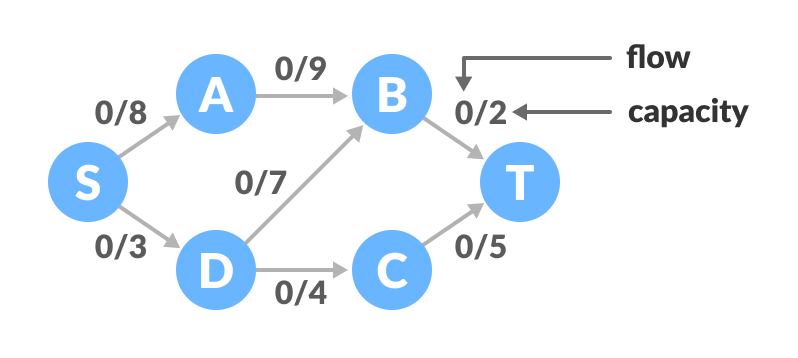
Terminologies Used
Augmenting Path
It is the path available in a flow network.
Residual Graph
It represents the flow network that has additional possible flow.
Residual Capacity
It is the capacity of the edge after subtracting the flow from the maximum capacity.
How Ford-Fulkerson Algorithm works?
The algorithm follows:
- Initialize the flow in all the edges to 0.
- While there is an augmenting path between the source and the sink, add this path to the flow.
- Update the residual graph.
We can also consider reverse-path if required because if we do not consider them, we may never find a maximum flow.
The above concepts can be understood with the example below.
Ford-Fulkerson Example
The flow of all the edges is 0 at the beginning.
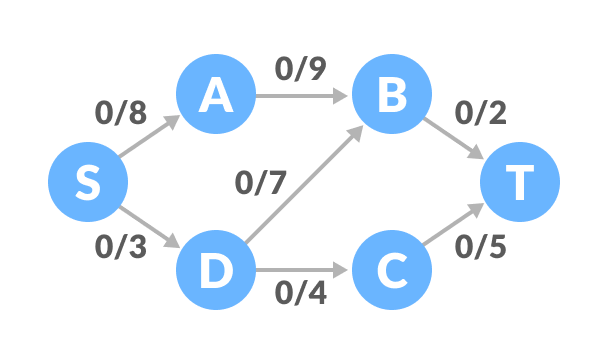
- Select any arbitrary path from S to T. In this step, we have selected path S-A-B-T.
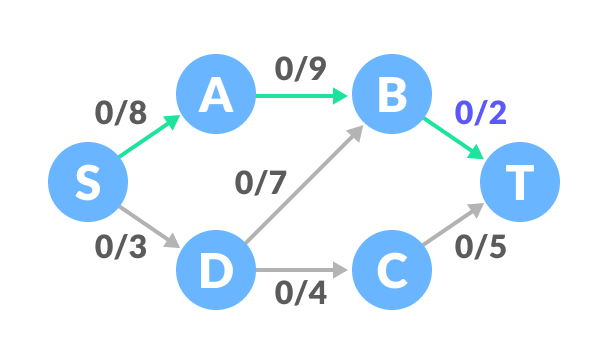
Find a path
The minimum capacity among the three edges is 2 (B-T). Based on this, update the flow/capacity for each path.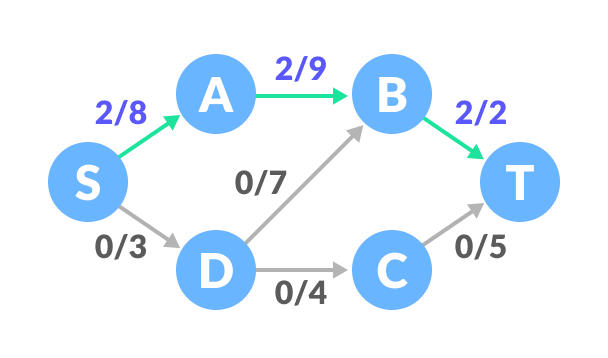
Update the capacities - Select another path S-D-C-T. The minimum capacity among these edges is 3 (S-D).
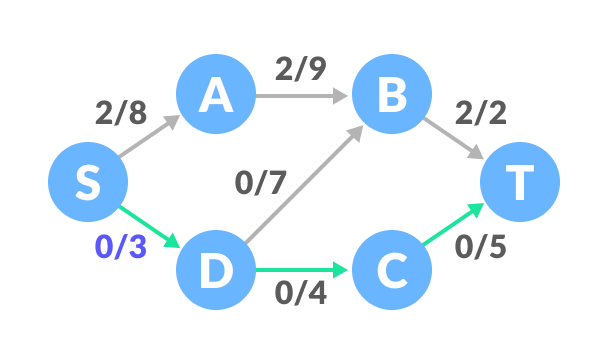
Find next path
Update the capacities according to this.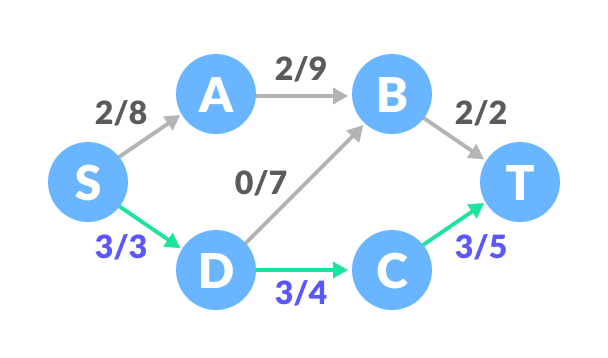
Update the capacities - Now, let us consider the reverse-path B-D as well. Selecting path S-A-B-D-C-T. The minimum residual capacity among the edges is 1 (D-C).
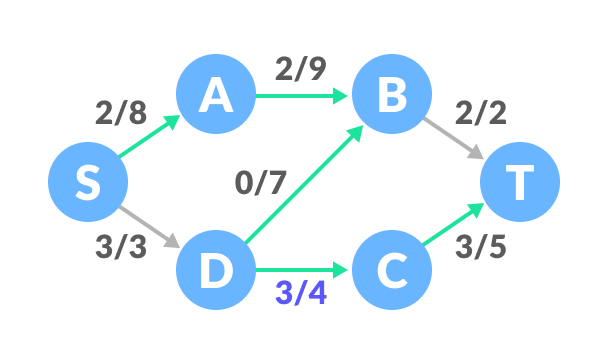
Find next path
Updating the capacities.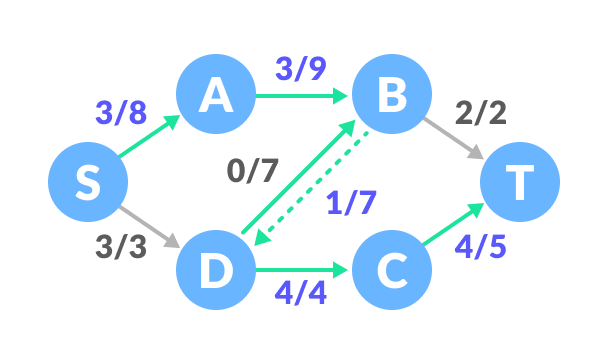
Update the capacities
The capacity for forward and reverse paths are considered separately. - Adding all the flows = 2 + 3 + 1 = 6, which is the maximum possible flow on the flow network.
Note that if the capacity for any edge is full, then that path cannot be used.
Python, Java and C/C++ Examples
# Ford-Fulkerson algorith in Python

from collections import defaultdict


class Graph:

    def __init__(self, graph):
        self.graph = graph
        self. ROW = len(graph)


    # Using BFS as a searching algorithm
    def searching_algo_BFS(self, s, t, parent):

        visited = [False] * (self.ROW)
        queue = []

        queue.append(s)
        visited[s] = True

        while queue:

            u = queue.pop(0)

            for ind, val in enumerate(self.graph[u]):
                if visited[ind] == False and val > 0:
                    queue.append(ind)
                    visited[ind] = True
                    parent[ind] = u

        return True if visited[t] else False

    # Applying fordfulkerson algorithm
    def ford_fulkerson(self, source, sink):
        parent = [-1] * (self.ROW)
        max_flow = 0

        while self.searching_algo_BFS(source, sink, parent):

            path_flow = float("Inf")
            s = sink
            while(s != source):
                path_flow = min(path_flow, self.graph[parent[s]][s])
                s = parent[s]

            # Adding the path flows
            max_flow += path_flow

            # Updating the residual values of edges
            v = sink
            while(v != source):
                u = parent[v]
                self.graph[u][v] -= path_flow
                self.graph[v][u] += path_flow
                v = parent[v]

        return max_flow


graph = [[0, 8, 0, 0, 3, 0],
         [0, 0, 9, 0, 0, 0],
         [0, 0, 0, 0, 7, 2],
         [0, 0, 0, 0, 0, 5],
         [0, 0, 7, 4, 0, 0],
         [0, 0, 0, 0, 0, 0]]

g = Graph(graph)

source = 0
sink = 5

print("Max Flow: %d " % g.ford_fulkerson(source, sink))
// Ford-Fulkerson algorith in Java

import java.util.LinkedList;

class FordFulkerson {
  static final int V = 6;

  // Using BFS as a searching algorithm
  boolean bfs(int Graph[][], int s, int t, int p[]) {
    boolean visited[] = new boolean[V];
    for (int i = 0; i < V; ++i)
      visited[i] = false;

    LinkedList<Integer> queue = new LinkedList<Integer>();
    queue.add(s);
    visited[s] = true;
    p[s] = -1;

    while (queue.size() != 0) {
      int u = queue.poll();

      for (int v = 0; v < V; v++) {
        if (visited[v] == false && Graph[u][v] > 0) {
          queue.add(v);
          p[v] = u;
          visited[v] = true;
        }
      }
    }

    return (visited[t] == true);
  }

  // Applying fordfulkerson algorithm
  int fordFulkerson(int graph[][], int s, int t) {
    int u, v;
    int Graph[][] = new int[V][V];

    for (u = 0; u < V; u++)
      for (v = 0; v < V; v++)
        Graph[u][v] = graph[u][v];

    int p[] = new int[V];

    int max_flow = 0;

    # Updating the residual calues of edges
    while (bfs(Graph, s, t, p)) {
      int path_flow = Integer.MAX_VALUE;
      for (v = t; v != s; v = p[v]) {
        u = p[v];
        path_flow = Math.min(path_flow, Graph[u][v]);
      }

      for (v = t; v != s; v = p[v]) {
        u = p[v];
        Graph[u][v] -= path_flow;
        Graph[v][u] += path_flow;
      }

      // Adding the path flows
      max_flow += path_flow;
    }

    return max_flow;
  }

  public static void main(String[] args) throws java.lang.Exception {
    int graph[][] = new int[][] { { 0, 8, 0, 0, 3, 0 }, { 0, 0, 9, 0, 0, 0 }, { 0, 0, 0, 0, 7, 2 },
        { 0, 0, 0, 0, 0, 5 }, { 0, 0, 7, 4, 0, 0 }, { 0, 0, 0, 0, 0, 0 } };
    FordFulkerson m = new FordFulkerson();

    System.out.println("Max Flow: " + m.fordFulkerson(graph, 0, 5));

  }
}
/ Ford - Fulkerson algorith in C

#include <stdio.h>

#define A 0
#define B 1
#define C 2
#define MAX_NODES 1000
#define O 1000000000

int n;
int e;
int capacity[MAX_NODES][MAX_NODES];
int flow[MAX_NODES][MAX_NODES];
int color[MAX_NODES];
int pred[MAX_NODES];

int min(int x, int y) {
  return x < y ? x : y;
}

int head, tail;
int q[MAX_NODES + 2];

void enqueue(int x) {
  q[tail] = x;
  tail++;
  color[x] = B;
}

int dequeue() {
  int x = q[head];
  head++;
  color[x] = C;
  return x;
}

// Using BFS as a searching algorithm
int bfs(int start, int target) {
  int u, v;
  for (u = 0; u < n; u++) {
    color[u] = A;
  }
  head = tail = 0;
  enqueue(start);
  pred[start] = -1;
  while (head != tail) {
    u = dequeue();
    for (v = 0; v < n; v++) {
      if (color[v] == A && capacity[u][v] - flow[u][v] > 0) {
        enqueue(v);
        pred[v] = u;
      }
    }
  }
  return color[target] == C;
}

// Applying fordfulkerson algorithm
int fordFulkerson(int source, int sink) {
  int i, j, u;
  int max_flow = 0;
  for (i = 0; i < n; i++) {
    for (j = 0; j < n; j++) {
      flow[i][j] = 0;
    }
  }

  // Updating the residual values of edges
  while (bfs(source, sink)) {
    int increment = O;
    for (u = n - 1; pred[u] >= 0; u = pred[u]) {
      increment = min(increment, capacity[pred[u]][u] - flow[pred[u]][u]);
    }
    for (u = n - 1; pred[u] >= 0; u = pred[u]) {
      flow[pred[u]][u] += increment;
      flow[u][pred[u]] -= increment;
    }
    // Adding the path flows
    max_flow += increment;
  }
  return max_flow;
}

int main() {
  for (int i = 0; i < n; i++) {
    for (int j = 0; j < n; j++) {
      capacity[i][j] = 0;
    }
  }
  n = 6;
  e = 7;

  capacity[0][1] = 8;
  capacity[0][4] = 3;
  capacity[1][2] = 9;
  capacity[2][4] = 7;
  capacity[2][5] = 2;
  capacity[3][5] = 5;
  capacity[4][2] = 7;
  capacity[4][3] = 4;

  int s = 0, t = 5;
  printf("Max Flow: %d\n", fordFulkerson(s, t));
}
// Ford-Fulkerson algorith in C++

#include <limits.h>
#include <string.h>

#include <iostream>
#include <queue>
using namespace std;

#define V 6

// Using BFS as a searching algorithm
bool bfs(int rGraph[V][V], int s, int t, int parent[]) {
  bool visited[V];
  memset(visited, 0, sizeof(visited));

  queue<int> q;
  q.push(s);
  visited[s] = true;
  parent[s] = -1;

  while (!q.empty()) {
    int u = q.front();
    q.pop();

    for (int v = 0; v < V; v++) {
      if (visited[v] == false && rGraph[u][v] > 0) {
        q.push(v);
        parent[v] = u;
        visited[v] = true;
      }
    }
  }

  return (visited[t] == true);
}

// Applying fordfulkerson algorithm
int fordFulkerson(int graph[V][V], int s, int t) {
  int u, v;

  int rGraph[V][V];
  for (u = 0; u < V; u++)
    for (v = 0; v < V; v++)
      rGraph[u][v] = graph[u][v];

  int parent[V];
  int max_flow = 0;

  // Updating the residual values of edges
  while (bfs(rGraph, s, t, parent)) {
    int path_flow = INT_MAX;
    for (v = t; v != s; v = parent[v]) {
      u = parent[v];
      path_flow = min(path_flow, rGraph[u][v]);
    }

    for (v = t; v != s; v = parent[v]) {
      u = parent[v];
      rGraph[u][v] -= path_flow;
      rGraph[v][u] += path_flow;
    }

    // Adding the path flows
    max_flow += path_flow;
  }

  return max_flow;
}

int main() {
  int graph[V][V] = {{0, 8, 0, 0, 3, 0},
             {0, 0, 9, 0, 0, 0},
             {0, 0, 0, 0, 7, 2},
             {0, 0, 0, 0, 0, 5},
             {0, 0, 7, 4, 0, 0},
             {0, 0, 0, 0, 0, 0}};

  cout << "Max Flow: " << fordFulkerson(graph, 0, 5) << endl;
}
Ford-Fulkerson Applications
- Water distribution pipeline
- Bipartite matching problem
- Circulation with demands
Huffman Coding
Huffman Coding is a technique of compressing data to reduce its size without losing any of the details. It was first developed by David Huffman.
Huffman Coding is generally useful to compress the data in which there are frequently occurring characters.
How Huffman Coding works?
Suppose the string below is to be sent over a network.

Each character occupies 8 bits. There are a total of 15 characters in the above string. Thus, a total of 8 * 15 = 120 bits are required to send this string.
Using the Huffman Coding technique, we can compress the string to a smaller size.
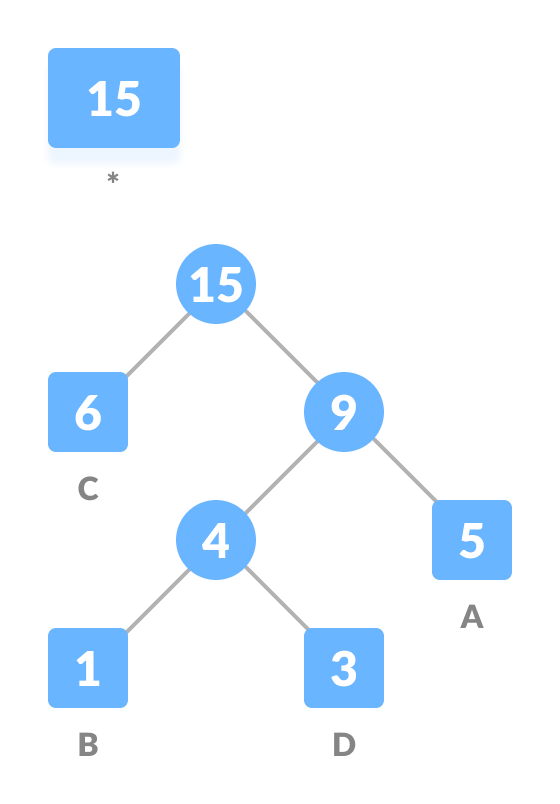
Huffman coding first creates a tree using the frequencies of the character and then generates code for each character.
Once the data is encoded, it has to be decoded. Decoding is done using the same tree.
Huffman Coding prevents any ambiguity in the decoding process using the concept of prefix code ie. a code associated with a character should not be present in the prefix of any other code. The tree created above helps in maintaining the property.
Huffman coding is done with the help of the following steps.
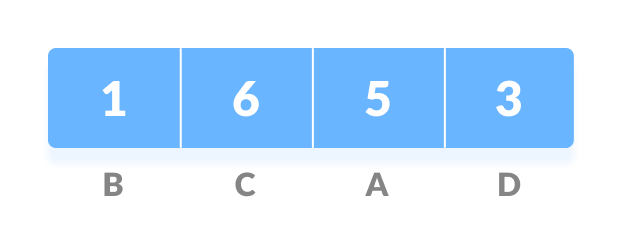
- Calculate the frequency of each character in the string.
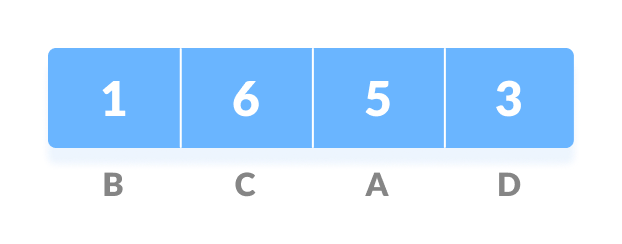
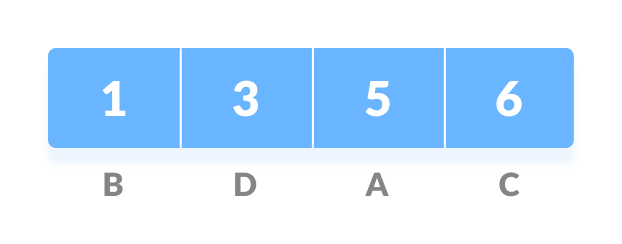
Frequency of string - Sort the characters in increasing order of the frequency. These are stored in a priority queue Q.
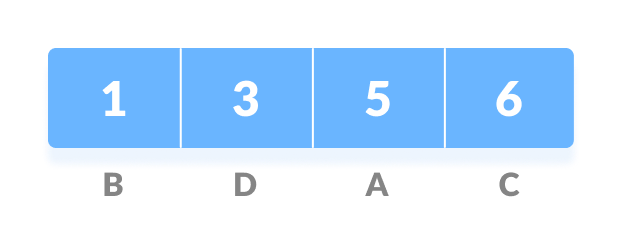
Characters sorted according to the frequency - Make each unique character as a leaf node.
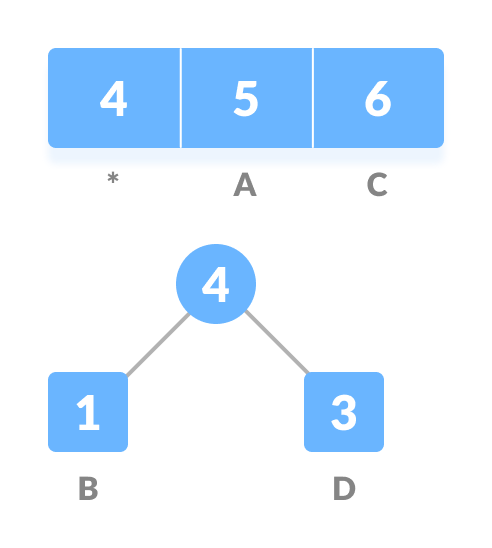
- Create an empty node z. Assign the minimum frequency to the left child of z and assign the second minimum frequency to the right child of z. Set the value of the z as the sum of the above two minimum frequencies.
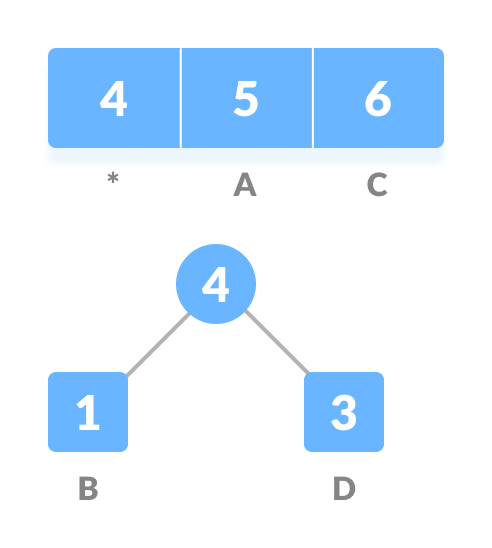
Getting the sum of the least numbers - Remove these two minimum frequencies from Q and add the sum into the list of frequencies (* denote the internal nodes in the figure above).
- Insert node z into the tree.
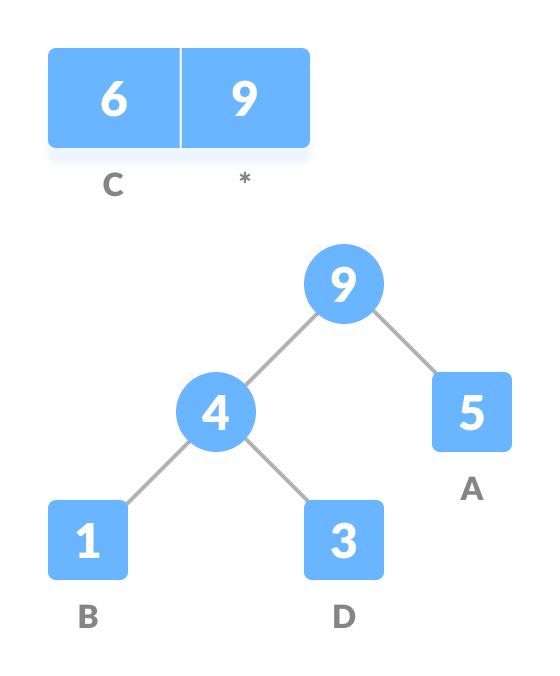
- Repeat steps 3 to 5 for all the characters.
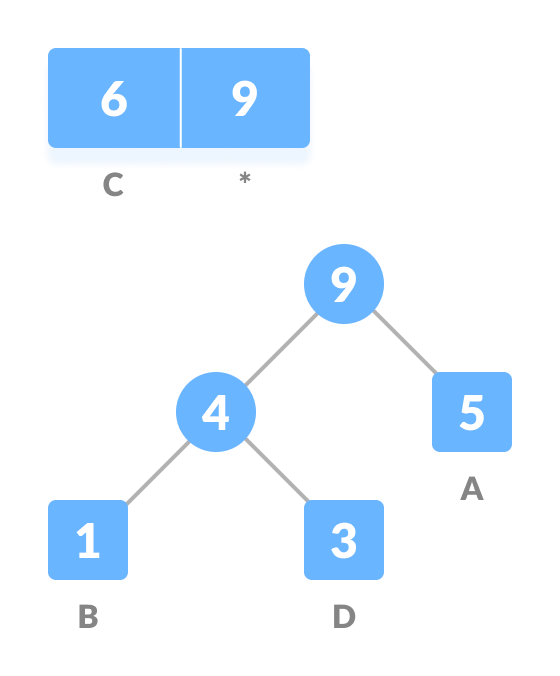
Repeat steps 3 to 5 for all the characters. 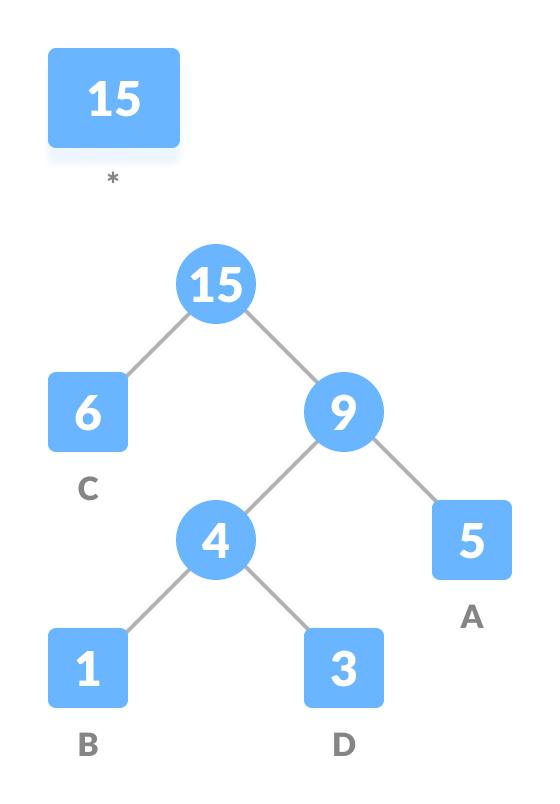
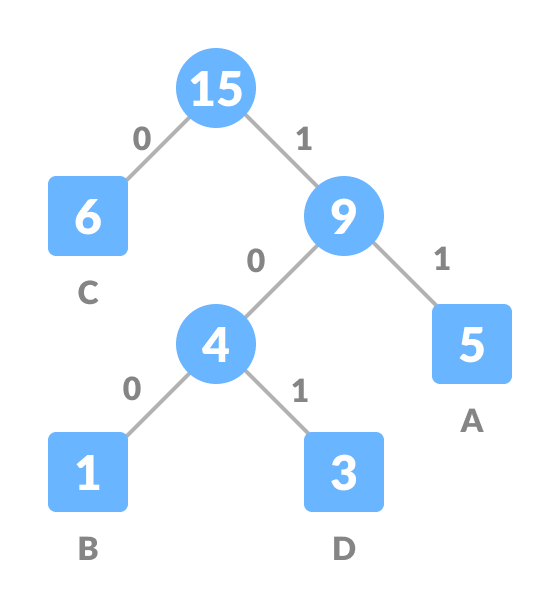
Repeat steps 3 to 5 for all the characters. - For each non-leaf node, assign 0 to the left edge and 1 to the right edge.
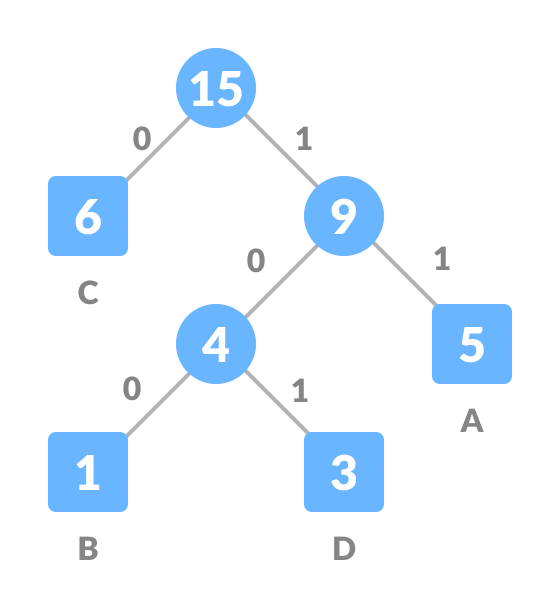
Assign 0 to the left edge and 1 to the right edge
For sending the above string over a network, we have to send the tree as well as the above compressed-code. The total size is given by the table below.
| Character | Frequency | Code | Size |
|---|---|---|---|
| A | 5 | 11 | 5*2 = 10 |
| B | 1 | 100 | 1*3 = 3 |
| C | 6 | 0 | 6*1 = 6 |
| D | 3 | 101 | 3*3 = 9 |
| 4 * 8 = 32 bits | 15 bits | 28 bits |
Without encoding, the total size of the string was 120 bits. After encoding the size is reduced to 32 + 15 + 28 = 75.
Decoding the code
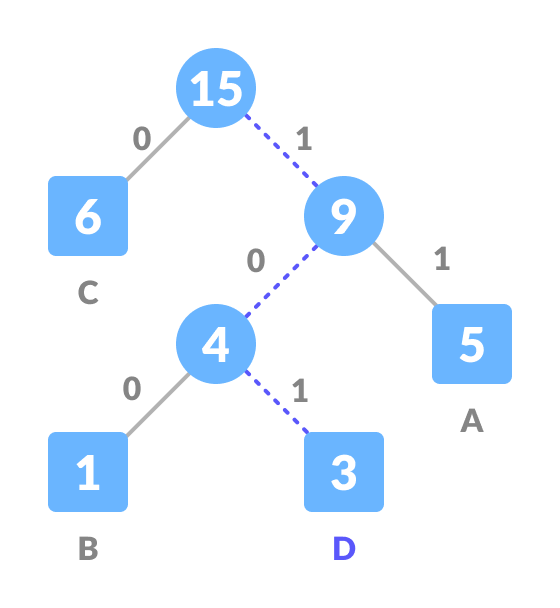
For decoding the code, we can take the code and traverse through the tree to find the character.
Let 101 is to be decoded, we can traverse from the root as in the figure below.
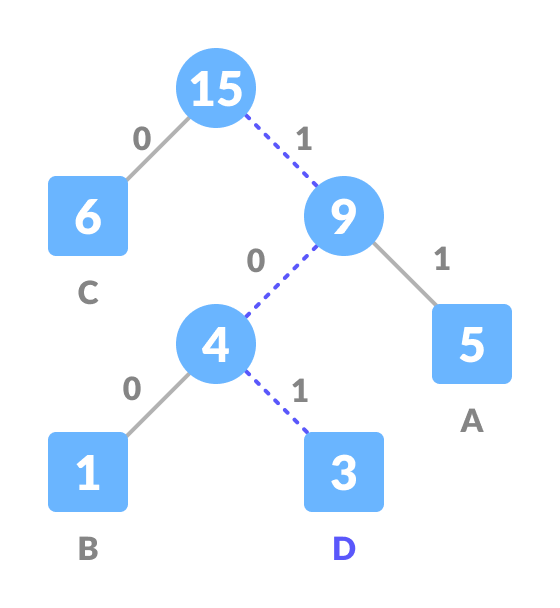
Huffman Coding Algorithm
create a priority queue Q consisting of each unique character.
sort then in ascending order of their frequencies.
for all the unique characters:
    create a newNode
    extract minimum value from Q and assign it to leftChild of newNode
    extract minimum value from Q and assign it to rightChild of newNode
    calculate the sum of these two minimum values and assign it to the value of newNode
    insert this newNode into the tree
return rootNode
Python, Java and C/C++ Examples
# Huffman Coding in python

string = 'BCAADDDCCACACAC'


# Creating tree nodes
class NodeTree(object):

    def __init__(self, left=None, right=None):
        self.left = left
        self.right = right

    def children(self):
        return (self.left, self.right)

    def nodes(self):
        return (self.left, self.right)

    def __str__(self):
        return '%s_%s' % (self.left, self.right)


# Main function implementing huffman coding
def huffman_code_tree(node, left=True, binString=''):
    if type(node) is str:
        return {node: binString}
    (l, r) = node.children()
    d = dict()
    d.update(huffman_code_tree(l, True, binString + '0'))
    d.update(huffman_code_tree(r, False, binString + '1'))
    return d


# Calculating frequency
freq = {}
for c in string:
    if c in freq:
        freq[c] += 1
    else:
        freq[c] = 1

freq = sorted(freq.items(), key=lambda x: x[1], reverse=True)

nodes = freq

while len(nodes) > 1:
    (key1, c1) = nodes[-1]
    (key2, c2) = nodes[-2]
    nodes = nodes[:-2]
    node = NodeTree(key1, key2)
    nodes.append((node, c1 + c2))

    nodes = sorted(nodes, key=lambda x: x[1], reverse=True)

huffmanCode = huffman_code_tree(nodes[0][0])

print(' Char | Huffman code ')
print('----------------------')
for (char, frequency) in freq:
    print(' %-4r |%12s' % (char, huffmanCode[char]))
// Huffman Coding in Java

import java.util.PriorityQueue;
import java.util.Comparator;

class HuffmanNode {
  int item;
  char c;
  HuffmanNode left;
  HuffmanNode right;
}

// For comparing the nodes
class ImplementComparator implements Comparator<HuffmanNode> {
  public int compare(HuffmanNode x, HuffmanNode y) {
    return x.item - y.item;
  }
}

// IMplementing the huffman algorithm
public class Huffman {
  public static void printCode(HuffmanNode root, String s) {
    if (root.left == null && root.right == null && Character.isLetter(root.c)) {

      System.out.println(root.c + "   |  " + s);

      return;
    }
    printCode(root.left, s + "0");
    printCode(root.right, s + "1");
  }

  public static void main(String[] args) {

    int n = 4;
    char[] charArray = { 'A', 'B', 'C', 'D' };
    int[] charfreq = { 5, 1, 6, 3 };

    PriorityQueue<HuffmanNode> q = new PriorityQueue<HuffmanNode>(n, new ImplementComparator());

    for (int i = 0; i < n; i++) {
      HuffmanNode hn = new HuffmanNode();

      hn.c = charArray[i];
      hn.item = charfreq[i];

      hn.left = null;
      hn.right = null;

      q.add(hn);
    }

    HuffmanNode root = null;

    while (q.size() > 1) {

      HuffmanNode x = q.peek();
      q.poll();

      HuffmanNode y = q.peek();
      q.poll();

      HuffmanNode f = new HuffmanNode();

      f.item = x.item + y.item;
      f.c = '-';
      f.left = x;
      f.right = y;
      root = f;

      q.add(f);
    }
    System.out.println(" Char | Huffman code ");
    System.out.println("--------------------");
    printCode(root, "");
  }
}
// Huffman Coding in C

#include <stdio.h>
#include <stdlib.h>

#define MAX_TREE_HT 50

struct MinHNode {
  char item;
  unsigned freq;
  struct MinHNode *left, *right;
};

struct MinHeap {
  unsigned size;
  unsigned capacity;
  struct MinHNode **array;
};

// Function declaration
void printArray(int arr[], int n);

// Create nodes
struct MinHNode *newNode(char item, unsigned freq) {
  struct MinHNode *temp = (struct MinHNode *)malloc(sizeof(struct MinHNode));

  temp->left = temp->right = NULL;
  temp->item = item;
  temp->freq = freq;

  return temp;
}

// Create min heap
struct MinHeap *createMinH(unsigned capacity) {
  struct MinHeap *minHeap = (struct MinHeap *)malloc(sizeof(struct MinHeap));

  minHeap->size = 0;

  minHeap->capacity = capacity;

  minHeap->array = (struct MinHNode **)malloc(minHeap->capacity * sizeof(struct MinHNode *));
  return minHeap;
}

// Function to swap
void swapMinHNode(struct MinHNode **a, struct MinHNode **b) {
  struct MinHNode *t = *a;
  *a = *b;
  *b = t;
}

// Heapify
void minHeapify(struct MinHeap *minHeap, int idx) {
  int smallest = idx;
  int left = 2 * idx + 1;
  int right = 2 * idx + 2;

  if (left < minHeap->size && minHeap->array[left]->freq < minHeap->array[smallest]->freq)
    smallest = left;

  if (right < minHeap->size && minHeap->array[right]->freq < minHeap->array[smallest]->freq)
    smallest = right;

  if (smallest != idx) {
    swapMinHNode(&minHeap->array[smallest], &minHeap->array[idx]);
    minHeapify(minHeap, smallest);
  }
}

// Check if size if 1
int checkSizeOne(struct MinHeap *minHeap) {
  return (minHeap->size == 1);
}

// Extract min
struct MinHNode *extractMin(struct MinHeap *minHeap) {
  struct MinHNode *temp = minHeap->array[0];
  minHeap->array[0] = minHeap->array[minHeap->size - 1];

  --minHeap->size;
  minHeapify(minHeap, 0);

  return temp;
}

// Insertion function
void insertMinHeap(struct MinHeap *minHeap, struct MinHNode *minHeapNode) {
  ++minHeap->size;
  int i = minHeap->size - 1;

  while (i && minHeapNode->freq < minHeap->array[(i - 1) / 2]->freq) {
    minHeap->array[i] = minHeap->array[(i - 1) / 2];
    i = (i - 1) / 2;
  }
  minHeap->array[i] = minHeapNode;
}

void buildMinHeap(struct MinHeap *minHeap) {
  int n = minHeap->size - 1;
  int i;

  for (i = (n - 1) / 2; i >= 0; --i)
    minHeapify(minHeap, i);
}

int isLeaf(struct MinHNode *root) {
  return !(root->left) && !(root->right);
}

struct MinHeap *createAndBuildMinHeap(char item[], int freq[], int size) {
  struct MinHeap *minHeap = createMinH(size);

  for (int i = 0; i < size; ++i)
    minHeap->array[i] = newNode(item[i], freq[i]);

  minHeap->size = size;
  buildMinHeap(minHeap);

  return minHeap;
}

struct MinHNode *buildHuffmanTree(char item[], int freq[], int size) {
  struct MinHNode *left, *right, *top;
  struct MinHeap *minHeap = createAndBuildMinHeap(item, freq, size);

  while (!checkSizeOne(minHeap)) {
    left = extractMin(minHeap);
    right = extractMin(minHeap);

    top = newNode('$', left->freq + right->freq);

    top->left = left;
    top->right = right;

    insertMinHeap(minHeap, top);
  }
  return extractMin(minHeap);
}

void printHCodes(struct MinHNode *root, int arr[], int top) {
  if (root->left) {
    arr[top] = 0;
    printHCodes(root->left, arr, top + 1);
  }
  if (root->right) {
    arr[top] = 1;
    printHCodes(root->right, arr, top + 1);
  }
  if (isLeaf(root)) {
    printf("  %c   | ", root->item);
    printArray(arr, top);
  }
}

// Wrapper function
void HuffmanCodes(char item[], int freq[], int size) {
  struct MinHNode *root = buildHuffmanTree(item, freq, size);

  int arr[MAX_TREE_HT], top = 0;

  printHCodes(root, arr, top);
}

// Print the array
void printArray(int arr[], int n) {
  int i;
  for (i = 0; i < n; ++i)
    printf("%d", arr[i]);

  printf("\n");
}

int main() {
  char arr[] = {'A', 'B', 'C', 'D'};
  int freq[] = {5, 1, 6, 3};

  int size = sizeof(arr) / sizeof(arr[0]);

  printf(" Char | Huffman code ");
  printf("\n--------------------\n");

  HuffmanCodes(arr, freq, size);
}
// Huffman Coding in C++

#include <iostream>
using namespace std;

#define MAX_TREE_HT 50

struct MinHNode {
  unsigned freq;
  char item;
  struct MinHNode *left, *right;
};

struct MinH {
  unsigned size;
  unsigned capacity;
  struct MinHNode **array;
};

// Creating Huffman tree node
struct MinHNode *newNode(char item, unsigned freq) {
  struct MinHNode *temp = (struct MinHNode *)malloc(sizeof(struct MinHNode));

  temp->left = temp->right = NULL;
  temp->item = item;
  temp->freq = freq;

  return temp;
}

// Create min heap using given capacity
struct MinH *createMinH(unsigned capacity) {
  struct MinH *minHeap = (struct MinH *)malloc(sizeof(struct MinH));
  minHeap->size = 0;
  minHeap->capacity = capacity;
  minHeap->array = (struct MinHNode **)malloc(minHeap->capacity * sizeof(struct MinHNode *));
  return minHeap;
}

// Print the array
void printArray(int arr[], int n) {
  int i;
  for (i = 0; i < n; ++i)
    cout << arr[i];

  cout << "\n";
}

// Swap function
void swapMinHNode(struct MinHNode **a, struct MinHNode **b) {
  struct MinHNode *t = *a;
  *a = *b;
  *b = t;
}

// Heapify
void minHeapify(struct MinH *minHeap, int idx) {
  int smallest = idx;
  int left = 2 * idx + 1;
  int right = 2 * idx + 2;

  if (left < minHeap->size && minHeap->array[left]->freq < minHeap->array[smallest]->freq)
    smallest = left;

  if (right < minHeap->size && minHeap->array[right]->freq < minHeap->array[smallest]->freq)
    smallest = right;

  if (smallest != idx) {
    swapMinHNode(&minHeap->array[smallest],
           &minHeap->array[idx]);
    minHeapify(minHeap, smallest);
  }
}

// Check if size if 1
int checkSizeOne(struct MinH *minHeap) {
  return (minHeap->size == 1);
}

// Extract the min
struct MinHNode *extractMin(struct MinH *minHeap) {
  struct MinHNode *temp = minHeap->array[0];
  minHeap->array[0] = minHeap->array[minHeap->size - 1];

  --minHeap->size;
  minHeapify(minHeap, 0);

  return temp;
}

// Insertion
void insertMinHeap(struct MinH *minHeap, struct MinHNode *minHeapNode) {
  ++minHeap->size;
  int i = minHeap->size - 1;

  while (i && minHeapNode->freq < minHeap->array[(i - 1) / 2]->freq) {
    minHeap->array[i] = minHeap->array[(i - 1) / 2];
    i = (i - 1) / 2;
  }

  minHeap->array[i] = minHeapNode;
}

// BUild min heap
void buildMinHeap(struct MinH *minHeap) {
  int n = minHeap->size - 1;
  int i;

  for (i = (n - 1) / 2; i >= 0; --i)
    minHeapify(minHeap, i);
}

int isLeaf(struct MinHNode *root) {
  return !(root->left) && !(root->right);
}

struct MinH *createAndBuildMinHeap(char item[], int freq[], int size) {
  struct MinH *minHeap = createMinH(size);

  for (int i = 0; i < size; ++i)
    minHeap->array[i] = newNode(item[i], freq[i]);

  minHeap->size = size;
  buildMinHeap(minHeap);

  return minHeap;
}

struct MinHNode *buildHfTree(char item[], int freq[], int size) {
  struct MinHNode *left, *right, *top;
  struct MinH *minHeap = createAndBuildMinHeap(item, freq, size);

  while (!checkSizeOne(minHeap)) {
    left = extractMin(minHeap);
    right = extractMin(minHeap);

    top = newNode('$', left->freq + right->freq);

    top->left = left;
    top->right = right;

    insertMinHeap(minHeap, top);
  }
  return extractMin(minHeap);
}
void printHCodes(struct MinHNode *root, int arr[], int top) {
  if (root->left) {
    arr[top] = 0;
    printHCodes(root->left, arr, top + 1);
  }

  if (root->right) {
    arr[top] = 1;
    printHCodes(root->right, arr, top + 1);
  }
  if (isLeaf(root)) {
    cout << root->item << "  | ";
    printArray(arr, top);
  }
}

// Wrapper function
void HuffmanCodes(char item[], int freq[], int size) {
  struct MinHNode *root = buildHfTree(item, freq, size);

  int arr[MAX_TREE_HT], top = 0;

  printHCodes(root, arr, top);
}

int main() {
  char arr[] = {'A', 'B', 'C', 'D'};
  int freq[] = {5, 1, 6, 3};

  int size = sizeof(arr) / sizeof(arr[0]);

  cout << "Char | Huffman code ";
  cout << "\n----------------------\n";
  HuffmanCodes(arr, freq, size);
}
Huffman Coding Complexity
The time complexity for encoding each unique character based on its frequency is O(nlog n).
Extracting minimum frequency from the priority queue takes place 2*(n-1) times and its complexity is O(log n). Thus the overall complexity is O(nlog n).
Huffman Coding Applications
- Huffman coding is used in conventional compression formats like GZIP, BZIP2, PKZIP, etc.
- For text and fax transmissions.