
Rust for Loop
In this tutorial, you will learn about the for loop in Rust with the help of examples.
The for loop in Rust is used to iterate a range of numbers. The syntax of for loop is:
for variable in lower_bound_number..upper_bound_number {
    // code block
}
Let's take a look at an example,
Example: Rust for Loop
fn main() {
    // usage of for loop
    for i in 1..6 {
        println!("{}", i);
    }
}
Output
1
2
3
4
5
In this example, we print numbers 1 to 5 using the for syntax. If we look at the example closely, we see
for i in 1..6 {
    println!("{}", i);
}
Here,
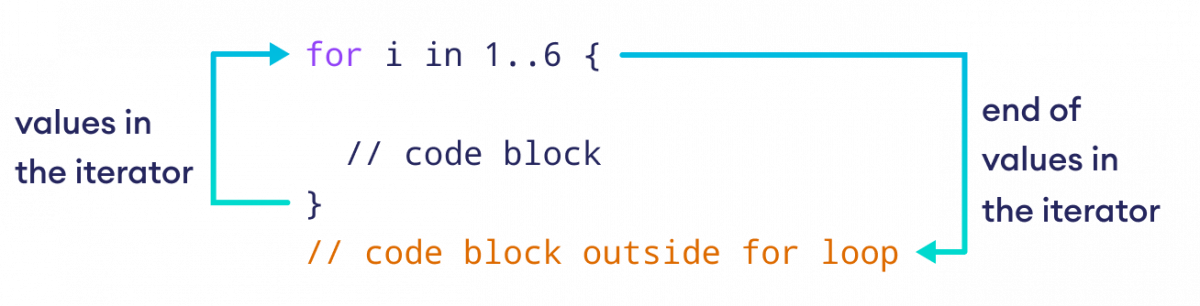
for- is the keyword to start anyforloopi- is known as the loop variable and should be a valid variable namein- is the keyword used to iterate over a series of values withfor1..6- is known as an Iterator where1is the lower bound and6is the upper bound. This yields values from 1 (inclusive) to 6 (exclusive) in steps of one.
Note: The for loop is also known as a for-in loop because of its syntax.
Working of for Loop
Example: Sum of First 10 Natural Numbers using for Loop
fn main() {
    let mut sum = 0;

    // for loop to iterate over first 10 natural numbers
    for i in 1..11 {
        sum += i;
    }

    println!("Sum: {}", sum);
}
Output
Sum: 55
Here, we loop over the iterator 1..11, which yields values from 1 to 10. A sum variable is created to sum all the values in each iteration. Finally, we print the sum of all the values.
Note: The 1..11 syntax is also known as a range notation or range operator used to create Iterators in Rust.
To learn more about iterators, visit Rust Iterator.
Frequently Asked Questions
for (i = 0; i < 10; i++) {
    printf("%d\n", i);
}
By design, Rust does not have the "C-style" for loop. The "C-style" for loop has four major components: initialization, condition, update expression and a loop body. With this syntax, the user needs to control and define every part of the code which is complicated and error prone.
The range notation ..= can be used for an inclusive range on both ends. For example, 1..=5 yields values from 1 (inclusive) to 5 (inclusive) in steps of one.
fn main() {
    // for loop with inclusive range notation
    for i in 1..=5 {
        println!("{}", i);
    }
}
Output
1
2
3
4
5
We can loop through an array using the same for..in syntax. For example,
fn main() {
    let fruits = ["Apple", "Orange", "Banana"];

    // for loop to iterate through items in an array
    for fruit in fruits {
        println!("{}", fruit);
    }
}
Output
Apple
Orange
Banana
To learn more about arrays, visit Rust Array.