
Rust while Loop
In this tutorial, you will learn about the while loop in Rust with the help of examples.
We use the while loop to execute a code block till the condition is true. The syntax for the while expression is:
while condition {
    // code block
}

// code block outside while loop
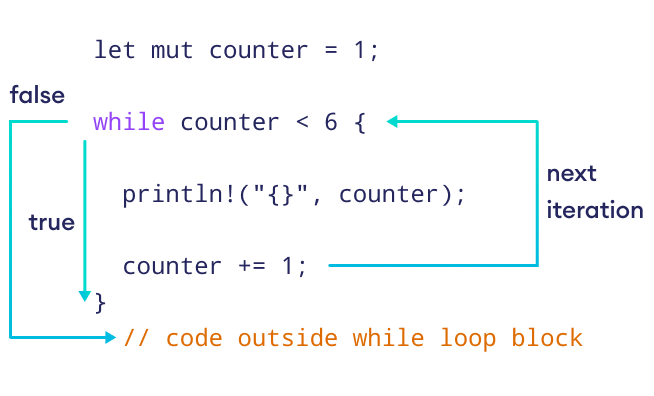
Here, the while loop evaluates the condition before proceeding further.
If the condition evaluates to:
true- the code block inside the while loop is executed and the condition is evaluated againfalse- the loop terminates and the code block outside the while loop is executed
Example: Rust while Loop
fn main() {
    let mut counter = 1;

    // usage of while loop
    while counter < 6 {
        println!("{}", counter);

        counter += 1;
    }
}
Output
1
2
3
4
5
In the example above, we have a condition:
while counter < 6 {
    // code block
}
Here, the loop keeps running till the counter variable is less than 6. Inside the loop, we are increasing the value of the counter by 1.
After 5th iteration, the value of counter will be 6, so the condition, counter < 6 becomes false and the loop is terminated.
Note: while expressions are generally used in conjunction with counter variables that help exit the loop after certain conditions.
Working of while Expression in Rust
Infinite while Loop
You can write a loop that never ends using the while expression. Let's look at an example,
fn main() {
    let counter = 1;

    // while loop with a condition that always evaluates to true
    while counter < 6 {
        println!("Loop forever!");
   }
}
Output
Loop forever!
Loop forever!
Loop forever!
.
.
.
This example code will print "Loop forever!" indefinitely because the condition counter < 6 always evaluates to true. It is because we never increase the value of the counter variable inside the loop. Thus, this program will run until the user terminates the program.
Note: You can use the break keyword to terminate any kind of loop in Rust.
Example: Multiplication Table Using while Loop
fn main() {
    // variable to print multiplication table for
    let i = 2;

    // counter variable that starts at 1
    let mut j = 1;

    // while loop that runs for 10 iterations
    while j <= 10 {
        // multiply i and j
        let mult = i * j;

        // print multiplication result on each iteration
        println!("{} * {} = {}", i, j, mult);

        // increase value of counter variable j
        j += 1;
    }
}
Output
2 * 1 = 2
2 * 2 = 4
2 * 3 = 6
2 * 4 = 8
2 * 5 = 10
2 * 6 = 12
2 * 7 = 14
2 * 8 = 16
2 * 9 = 18
2 * 10 = 20
Nested while Loop
We can use a while loop inside the body of another while loop. This is known as a nested while loop. A nested while loop looks like:
while outer_condition {
    // outer code block 1

    while inner_condition {
        // inner code block
    }

    // outer code block 2
}
Let's print a pattern using a nested while loop,
fn main() {
    // outer loop counter
    let mut i = 1;

    // outer loop
    while i <= 5 {
        // inner loop counter
        let mut j = 1;

        // inner loop
        while j <= 5 {
            print!("*");

            // increase inner loop counter
            j += 1;
        }

        println!("");

        // increase outer loop counter
        i += 1;
    }
}
Output
*****
*****
*****
*****
*****
In the above example,
- The outer
whileloop iterates5times - The inner
whileloop inside of the outerwhileloop also iterates5times - The inner
whileloop prints an asterisk(*) →print!(*)on every iteration - The inner
whileloop stops when the counter variable j reaches to6as the inner condition evaluates tofalse - The outer
whileloop prints a new line →println!("")on every iteration and goes to the next iteration which will initiate the innerwhileloop again - The outer
whileloop stops when the counter variable i reaches to6as the outer condition evaluates tofalse